A long, long time ago (twelve years ago to
be exact), there was a website about werewolves that had a huge list of
werewolf movies from the very beginning to what was then the present. From what
I know, the website hasn’t been around for a long time, since it disappeared
from the waves of the Internet ocean still during the time when I was writing
posts on my first blog as a teenager. And so, with Werewolf Theory reborn, I
decided to scrape up what I had once saved from the mentioned website, revise
it with my own knowledge of werewolf cinema and make a giant list of my own for
all those interested to see. Because of its size, I’ve decided that it will be
a good thing to split it into parts. The first part, which is this post, will
cover productions from the year 1913 up to and including year 1949. The
subsequent parts have their time-span yet to be determined, depending on the
size of each post. The lists will mostly feature werewolf movies, but in some
cases they will also list productions that are not strictly werewolf-themed,
but in which werewolves have appeared for longer than just a cameo. For those I
have the Werewolf Cameos series of posts. Anyway, I hope you find this list of
mine informative. Enjoy!
1913
The Werewolf
Regarded as the first ever made werewolf movie and the earliest of Universal Pictures monster movies, this silent film short tells the story of an Indian woman who becomes a witch and passes her knowledge of witchcraft to her daughter. The girl transforms into a wolf and carries out vengeance against white American settlers. The film is considered lost since it was supposedly destroyed in a fire at Universal Studios in 1942.
1923
Le Loup-Garou
A French silent film whose premise revolves around a priest who is murdered and curses his killer so that he transforms into a wolf. The werewolf begs God for forgiveness for what he has done, but instead of the curse being lifted from him, he is struck and, as a result, killed by lightning.
1925
Wolf Blood
(Wolfblood: A Tale of the Forest)
A silent film starring, and directed by, George Chasebro. It tells the story of Dick Bannister, who becomes the new field boss of the Canadian Ford Logging Company. At the time, the company is waging a private war with a rival logging company. When the conflict turns bloody, Dick is wounded and loses so much blood that he requires a transfusion. Since no human wants to volunteer, Dick is given the blood of a wolf. Medical probabilities aside, soon afterwards Dick starts having dreams of running with a pack of wolves, while the rival loggers begin dying to wolf attacks. Subsequently, his fellow lumberjacks come to the conclusion that Dick is a werewolf.
1932
Le Loup Garou
(Werewolf)
The first sound film to feature a
werewolf. Directed by Friedrich Feher and based on Alfred Machard’s novel Der
Schwarze Mann, the movie has been lost to time.
1935
Werewolf of London
The first mainstream Hollywood werewolf
movie by Universal Studios. Wilfred Glendon (Henry Hull), a renowned English
botanist, travels to Tibet in search of a rare mariphasa plant. While there, he
is bitten by a werewolf and starts to transform himself during the next full
moon. It turns out that the mariphasa plant can be made into a temporary
antidote for lycanthropy, but when the flower does not bloom, Glendon goes on a
killing spree through the streets of London. He tries to isolate himself from
other people, but the beast within seems to always find a way to escape its
confinement.
1941
The Wolf Man
The first of many movies featuring Lon
Chaney, Jr. as the Wolf Man. Larry Talbot (Lon Chaney, Jr.) returns from the
USA to his hometown after the unexpected death of his brother and reunites with
his father. One night, as he fends off an attack by what he thinks is a wolf,
he is bitten by the animal that turns out to have been a werewolf. Soon, Larry
starts changing into a wolf-man and prowls the nearby woods in search of his
next victim.
The Hammond family has been cursed with
lycanthropy since the times of the Holy Crusades, but the only thing the public
knows is that its members have been dying under mysterious circumstances or
committing suicide. When two people are attacked by an unknown creature, Robert
Curtis (James Ellison) and his partner Christy (Heather Thatcher) are sent to
investigate the crimes and find a rational explanation for what the locals
believe to be a result of the Hammonds’ family curse. When the monster kidnaps
a woman, the police chase it down and shoot it, revealing that the creature
responsible for the attacks was a werewolf member of the Hammond family.
The Mad Monster
Dr. Lorenzo Cameron is a mad scientist
seeks revenge on his peers by developing a serum made from a wolf’s blood that
turns his gardener (and test subject) into a bloodthirsty wolf-man. He then
uses the wolf-man to kill the fellow scientists that ridiculed his beliefs and
made him lose his job at a university. A newspaper reporter begins to
investigate the killings and he begins to suspect the scientist of being the
culprit. In the end, the wolf-man turns on his master and kills him, while the
laboratory burns down, burying all the evidence of what has really happened.
1943
Le Loup des Malveneur
A French film directed by Guillame Radot.
Similarly to the family from The Undying Monster, a curse hangs
upon the Malveneur family – its first-born male members are doomed to transform
into wolves by night. Once a family of hunters, they are now the hunted
monsters. The last member of the family, who happens to be a scientist,
conducts mysterious experiments in order to find a cure and revive his
ancestors. Once people start disappearing, a detective is sent to investigate.
The movie incorporates themes from both Arthur Conan Doyle’s The Hound
of the Baskervilles and Mary Shelley’s Frankenstein.
Frankenstein Meets the Wolf Man
The sequel to 1941’s The Wolf Man.
On the night of a full moon, graverobbers break into the Talbot family crypt,
where Larry Talbot was laid to rest after the events of The Wolf Man.
When they remove the wolfsbane that was buried with him, the full moon’s light
revives Larry, to the horror of the graverobbers. He escapes and travels to the
remains of Dr. Frankenstein’s castle, where he hopes to either find a way to
cure himself of lycanthropy or permanently end his life. It is there that he comes
across Frankenstein’s monster.
1944
The Return of the Vampire
An unofficial continuation of Bela Lugosi’s
version of Dracula from 1931, where Lugosi plays Count Dracula
in all but name. Generally speaking, this is a vampire movie, so I’m not going
to write a summary of it. The reason why it’s on this list is the fact that the
titular vampire’s servant is a werewolf, whose lycanthropy is somehow bound to
his master’s existence, for when the vampire is killed with a stake, the
werewolf returns to his human form. After the vampire is revived, however, he
becomes a werewolf again and once more serves his master.
The Three Stooges: Idle Roomers
A short film featuring the American
slapstick comedy team, the Three Stooges. In it, the trio work as bellboys at a
hotel where they are trying to win the affection of an attractive female guest.
It turns out that the woman’s husband has somehow smuggled a wolf-man into the
hotel. Lupe the Wolf Man, for that’s his name, goes berserk whenever he hears
music, so when one of the bellboys turns on the radio while cleaning his room,
all hell breaks loose.
House of Frankenstein
Another movie with Lon Chaney, Jr. in the
role of the Wolf Man, this movie continues the story from 1943’s Frankenstein
Meets the Wolf Man. Dr. Gustav Niemann (played by Boris Karloff) seeks
revenge on Burgermeister Hussman, who once caused his imprisonment. He visits
the flooded ruins of Frankenstein’s castle and finds Frankenstein’s monster and
the Wolf Man frozen in the water. He thaws the two of them out and promises to
help Larry Talbot find a cure for his lycanthropy. He is not one to keep his
promises, however, and Larry transforms into a wolf-man and starts killing
people. Eventually, Larry is shot with a silver bullet by a Gypsy girl who has
fallen in love with him.
Cry of the Werewolf
Based on a story by Griffin Jay, the movie
tells of a Romani princess supposedly descended from Marie La Tour, an 18th
century French noblewoman. She has the ability to transform into a wolf - a
trait she inherited from her mother. When she learns that the location of Marie
La Tour’s tomb has been discovered, she decides to kill everyone privy to this
information, because it is considered a sacred place whose whereabouts are to
be known only to her family.
1945
House of Dracula
Yet another Universal Studios production
that puts Dracula, Frankenstein’s monster, and the Wolf Man together on one
screen. Once again, this movie continues the story of its predecessor, House
of Frankenstein from a year before. Count Dracula (John Carradine)
comes to the fictional town of Visaria to meet with Dr. Edelmann, saying that
he is looking for a cure for vampirism. At the same time, Larry Talbot arrives
at the castle (wait, didn’t he get shot in the previous film?) and wants
Edelmann to develop a cure for his werewolfism. The doctor claims that Talbot’s
transformations may be caused by pressure in his brain - and not by moonlight -
and undertakes the task of curing him. Eventually, he succeeds in curing Larry
of werewolfism by relieving the pressure in his skull (yeah right), but while
trying to cure Dracula, he becomes a vampire himself.
1946
She-Wolf of London
(Curse of the Allenbys)
Phyllis Allenby is a content noblewoman
who is about to be married to an aristocratic lawyer. She lives in her family’s
manor in London with her aunt, cousin, and a servant. Suddenly, people start being killed at the local park, their throats ripped by what seems to be a
wild animal. Rumours about werewolf attacks spread through the city and some
people claim to have seen a “she-wolf” emerge from the Allenby manor
and head for the park. At the same time, Phyllis wakes up with blood on her
hands, unable to remember what happened the previous night. She starts
believing that she is the female werewolf responsible for the murders, affected
by the legendary curse of the Allenby family.
1948
Abbot and Costello Meet Frankenstein
Abbot and Costello were the most popular
American comedy duo in the 1940s and early 1950s. This movie was the first of a
number of productions in which the two comedians come across classic Universal
Studios monsters. Here, Abbot and Costello play two baggage clerks, Chick and Wilbur,
respectively. They are contacted by Larry Talbot (Lon Chaney, Jr.) – who, for
some reason, is once again a werewolf (so much for that brain pressure
relieving therapy, I guess) – who tries to warn them that a shipment they’re
handling is dangerous because it contains the bodies of Count Dracula (Bela
Lugosi) and Frankenstein’s monster (Glenn Strange) en route to McDougal House
of Horrors. As we can expect, Dracula awakes upon arrival and devises a plot to
revive Frankenstein's monster and replace its brain with that of Wilbur’s. Together with
Larry Talbot, the two comedians have to act to stop Dracula’s plans.
* * *
And that would be it for Part I of the
Werewolf Cinematic Timeline. Phew, I have to say it took me a while to get all
these short summaries together. I actually had to cut the post earlier than
planned, because it was getting too long. Stay tuned for Part II, which will
list productions from 1950 up to and including 1979 (at least that’s the plan),
where their numbers begin to visibly increase. See you next time!
This time I decided to write a slightly different post, not concentrating on a single piece of work, but featuring a few at a time. The reason for this is simple – sometimes werewolves appear in movies and video games for a moment as cameos to accentuate a point that the movie/video game is making. These appearances are hence too brief to be given separate articles. That is why I decided to start a series (hopefully) of posts with a few such werewolf cameos at once, so that the post itself isn’t the length of a tweet ;) That said, I hope you enjoy this mini-series that will be popping out every now and then as soon as I gather enough examples to include. The order in which I list these is completely random, by the way. And I think that posting them in threes will be just about right for now. Might be more, depending on the amount of material. As always - enjoy!
Despicable Me (2010)
A werewolf is briefly shown in 2010’s animated movie Despicable Me when the main character, Gru, succeeds in shrinking the moon in order to steal it. The werewolf is shown howling at the moon, but once the moon is shrunk and disappears from the sky, he quickly transforms back into a human, confused at what has happened.
The Last of Us (2013)
At the very start of the game, we control a young girl and navigate through her home as we witness the beginning of the fungal zombie apocalypse. If we inspect the interior of her room, on the wall next to the bed we will find a fictional werewolf movie poster. The movie is called “Dawn of the Wolf” and there are mentions of it later on in the game. It is referenced in a conversation between the two main characters, Ellie and Joel. Subsequently, if you inspect the walls of the hotel the main characters find themselves passing through or look at some poster frames out on the streets, there are also posters for "Dawn of the Wolf, Part II". Additionally, Joel describes it as a “dumb teen movie”, which, all in all, strongly suggests that the whole idea is Naughty Dog’s way of parodying Dawn of the Dead (because of the title) and the Twilight saga (because of its being a multi-part teenage movie hit featuring a woman in love with a supernatural being, in this case a werewolf).
But that's not all. Yet another werewolf cameo occurs in the DLC pack, "Left Behind", where Ellie and her friend visit a store which sells Halloween merchandise. On one of the shelves they find masks and the one Ellie puts on is based on the werewolf from An American Werewolf in London.
Big Bad Beetleborgs (1996-1998)
Ah yes, now this takes me back to my puppy days. In this American live-action television series, three kids obtain the power to transform into their favourite comic book heroes after they accidentally release a phantasm named Flubber during their visit at the supposedly haunted Hillhurst Mansion. It is then revealed that Hillhurst Mansion is home to a group of (classic Universal Studios) monsters that the children befriend (more or less, since the monsters still want to eat them, but are always outsmarted by them). One of these monsters is Wolfgang “Wolfie” Smith – a werewolf who acts more like a pet dog and is treated as such by the other residents of the mansion. He speaks in yelps, growls and barks, similarly to Scooby Doo, and can be understood only by another monster, Count Fangula, who acts as his translator.
And that is it for the first part of the Werewolf Cameos series. More will come in the future, of course. For now, I hope you’ve enjoyed this post and I will see you again soon!
Recently, my boyfriend and I have
been replaying Ōkami and only now
have I realised I’ve omitted a notable character that appears in the game, who
displays werewolf qualities. That character is Oki and he will be the subject
of today’s article.
Concept art for Oki showing his human and wolf forms
Oki (short for Okikurumi, also spelled Okikurmi)
is a character that appears in Capcom’s 2006 action-adventure video game Ōkami which tells the story of how the
great Shinto sun goddess Amaterasu descends into the human world in the form of a wolf and embarks on
a divine mission to rid the land of Nippon (Japan) of the corruption spread by
the demonic Yamata no Orochi and his supporters.
The game is filled to the brim with characters
taken from Japanese mythology and folklore and it is no different for Oki. He
is based on the figure of an Ainu hero of lore, Okikurumi, with a couple of
twists here and there. The Ainu are an indigenous people of Japan, who originally inhabited Hokkaido and
north-eastern Honshu, as well as parts of Russia (Sakhalin and the Kuril
Islands). Okikurumi was a hero of mythology poems called oina, part of the Ainu creation myths. According to legend, Okikurumi
was born when Pa Kor Kamui (the Pestilence God), while flying above the
newly-created land, sat on a branch of an elm tree to rest. The goddess of the
elm tree, Cikisani, became pregnant due to this and bore a son – Okikurumi. Because the Ainu people used the wood of elm trees to start fires, Okikurumi quickly became
associated with the element of fire. He was also said to have taught the people
of earth how to hunt and fish and when he became an adult, his mother,
Cikisani, presented him with a magic sword with which he conquered demons and
evil spirits of the world.
Amaterasu first encounters Oki
in the land of Kamui (more about the significance of the land’s name below), a
snowy region in the northern part of Nippon. He appears as a young man in
purplish-blue clothes and a red sleeveless vest embroidered with white symbols,
with long red-and-black hair, wearing a mask that resembles either a blue bear
or a wolf, and wielding the sacred sword Kutone. At first, Oki attacks Amaterasu
with his sword, but when the goddess defeats him in his human form, he
transforms into a large dark-furred wolf with a red mane, the white symbols
becoming a pattern on his back, his mask, pendant, and sword remaining as his
accessories. As a wolf, Oki can still speak and he battles using not only his
lupine features, but also his sword. After he is once again defeated by
Amaterasu, Oki turns back into a human and commends her and acknowledges that
she is not an ordinary wolf. He informs her that he is a warrior of the Oina
tribe (a reference to the Ainu mythology poems in which his original
counterpart featured) that inhabit Kamui and that he has stolen the sacred
sword Kutone in order to vanquish demons that have caused a deadly blizzard to
rage in the region. Subsequently, Oki accompanies Amaterasu on her journey to
slay demons in hope of sating his sword’s thirst for demon blood and stopping
the blizzard raging in Kamui.
Wolf form Oki and Amaterasu
One thing to note here is that if
you look at the concept artwork for Oki or look at his sword during the game,
you will notice that the hilt and scabbard resemble wood and both have
totem-like carvings on their surface. The fact that Oki possesses a sword with
a hilt that resembles a totem is no coincidence. The Ainu’s religion featured
animism – a worldview that animals, plants, and some inanimate objects possess a spiritual essence. This spiritual
essence, or divine spirit, was called “kamui” (or “kamuy”) – the same name as
the land in which Oki and his tribe live and where Amaterasu first encounters
him. From this, we can deduce that the totem-hilt of the sword (or the
fang-shaped pendant Oki never parts with) acts as a conduit between Oki and the
wolf spirit, similarly to how tribal shamans channel the spirits through their
bodies, allowing him to transform into a wolf. It’s just a theory, though,
since I don’t remember if we see Oki shapeshift again after he returns Kutone
to his village’s shrine. I wasn’t able to find any mention of the legendary
Okikurumi being able to turn into a wolf, so I am going to go out on a limb and
say that Clover Studios, the developers of Ōkami,
simply combined his character with elements of Ainu beliefs.
I hope you’ve
enjoyed this post and I’ll see you next time! As a bonus, here is a GIF of Oki transforming into his wolf form for the first time :)
Oki transforms into a wolf during his fight with Amaterasu
Since I am now part of Amazon’s Affiliate
program, you can support me by purchasing a copy of your own of Ōkami from Amazon!
Should my article spark your interest in the game (as it should, since Ōkami is an amazing game) – please consider buying
it using the link provided below. Simply click on the cover of
the game on the right-hand side and you will be sent to
a page listing all the offers related to it! Thank you and enjoy!
Click here to shop for
the Playstation 3 HD Remastered
version ofŌkami!
Sources:
Donald
L. Philippi, Songs of Gods, Songs of
Humans: The Epic Tradition of the Ainu, Princeton University Press, 1979
Click here to view details about the movie, rent, or buy it from Amazon Video.
Hello and welcome to another dose of shapeshifting extravaganza!
Having explored a fragment of Japanese folklore in the 2012 animated movie Wolf Children, the time has come for us to go back into the past, seventy-four years to be exact, to a time when Universal Pictures monster movies were all the rage.
This month I bring to you a movie that has become a classic for all werewolf fans – The Wolf Man. I am, of course, talking about the original version from 1941 – but do not fret, I am planning to take care of the 2010 remake in the next instalment of my Werewolf Movie Reviews, after which I would like to also write an article comparing the two. I’ve actually spent quite some time deciding on how to do this – do I only write one article where I analyse both versions, or do I scrutinise each in a separate post and then write a third one on that basis? In the end, as you can see, I decided on the latter and perhaps it will be for the better – there’s no way I could half-arse an article about such a classic in our beloved field of interest! It will probably take me some time and, for sure, a lot of effort, but at least I won’t have any regrets. So here we go, let us take a look at the black-and-white jewel of a forgotten era, which spawned so many werewolf tropes that have been re-emerging every now and again in various productions, not only cinematic, throughout the years even to this day.
The Wolf Man is Universal Pictures’ second werewolf movie and it is probably a lot more well-known than its predecessor, Werewolf of London from 1935. Directed by George Waggner and written by Curt Siodmak, it stars Lon Chaney, Jr. as the protagonist, with Claude Rains, Evelyn Ankers, Ralph Bellamy, Patric Knowles, Béla Lugosi (famous for his portrayal of Count Dracula in the 1931 film version of Bram Stoker’s Dracula), and Maria Ouspenskaya in the roles of supporting characters. The Wolf Man spawned as many as four sequels (under varying titles) in the following years, which also featured Lon Chaney, Jr. in the role of the Wolf Man. What is interesting, the Wolf Man is the only Universal monster to be played by the same actor in all his film appearances in the 1940s. Lon Chaney, Jr. was so proud of his creation that he would go on to play a wolf man (even if not the Wolf Man) in the 1959 Mexican film La Casa del Terror (House of Terror), an episode of the American TV drama Route 66, as well as a scene in his last film, the 1971’s Dracula vs. Frankenstein. The Wolf Man is one of three best-known Universal Studios monsters that do not have a direct literary source. Over the last seventy-odd years, the movie has had a great influence on popular culture, with references to it made not only in other movies (e.g. La maldición de la bestia, An American Werewolf in London, The Howling, Cursed), but also in songs (e.g. Iced Earth’s Wolf, Cradle of Filth’s Queen of Winter, Throned, Florence + The Machine’s Howl), games (e.g. Capcom’s Darkstalkers), short stories (e.g. Neil Gaiman’s Smoke and Mirrors), and comic books (e.g. Screamland).
Click here to shop for The Wolf Man: The Complete Legacy Collection on
Amazon!
Since I am now part of Amazon’s Affiliate
program, you can support my blog by purchasing a copy of your own or renting The Wolf Man from Amazon Video!
Should my analysis and review spark your interest in the movie – or should you
want to view it yourself before reading this article – please consider buying or renting it using the link provided in its cover image at the top of the article. Apart from Amazon Video, a physical version called The Wolf Man: The Complete Legacy Collection is also available for purchase (link in the image on the right). Thank you and enjoy!
Summary
Larry Talbot (Lon Chaney, Jr.) returns to his ancestral home, Talbot Castle, in Llanwelly, Wales, after the death of his brother. He tries to reconcile with his estranged father, Sir John Talbot (Claude Rains) and falls in love with a local girl named Gwen Conliffe (Evelyn Ankers). One night, as he tries to fend off a wolf that attacks Gwen’s friend, Jenny, Larry is bitten by the animal. Afterwards, a Gypsy fortuneteller by the name of Maleva (Maria Ouspenskaya) reveals to him that the creature that bit him was, in fact, her son, Béla (Béla Lugosi) – a werewolf – and tells him that he, too, has become a werewolf. Soon after, Larry transforms into a wolf-man and hunts the people of the village. He struggles to overcome the beast within and find a way to cure himself, but eventually meets his demise.
In-depth analysis
The movie begins with a definition of lycanthropy. In order to suit the movie and provide the setting for the plot, this definition includes a mention of Talbot Castle and the nearby village. In case the title, written in a furry font that is supposed to make it look, well, hairy, wasn’t enough, this provides the viewer with an idea of what the movie will be about. This is to be expected, because at the time there weren’t that many movies about werewolves, so I can understand the need for such a clarification.
We then witness Larry Talbot’s arrival at Talbot Castle. We learn that his older brother died in a hunting accident and that he is now the sole heir to the Talbot family’s estate and riches. Since he has been away for eighteen years, working in the USA, Larry tries to mend his ties with his father, Sir John Talbot, an avid astronomer.
Having installed a new component for his father’s telescope, Larry does, well, what some men equipped with telescopes or binoculars do – he ends up spying on a girl as she puts on her earrings (nowadays, she would be undressing, probably). He takes a liking to the girl and notes that she lives above Charles Conliffe’s Antiques shop, which he decides to pay a visit to. It turns out that the girl, Gwen, works at her father’s shop as the shopkeeper. To start a conversation with her, Larry pretends to be looking for a gift. He eventually picks up a (now famous) cane with a silver wolf and a pentagram at the top.
Larry first comments that it features a dog, but Gwen quickly corrects him that it is, in fact, a wolf. She then explains that the pentagram with a wolf’s silhouette inside is the sign of the werewolf. When Larry asks her what a werewolf is, she provides him (and the audience) with another definition. Perhaps it is because of the time gap that almost equals my grandmother’s age that separates me from the contemporaries of this production, but I find it hard to believe in someone as worldly as Larry not knowing what a werewolf is. But I digress. Gwen defines a werewolf as ‘a human being who at certain times of the year changes into a wolf’, which is a bit of a bizarre definition, because what are we to understand by ‘certain parts of the year’? It seems like a very roundabout way of saying ‘every month during and/or around the full moon’. Subsequently, Gwen makes a reference to Brothers’ Grimm fairytale about Little Red Riding Hood, saying it was a werewolf story, and then recites ‘a famous poem’ that is so well-known to us werewolf fans today:
Even a man who is pure in heart
And says his prayers by night
May become a wolf when the wolfbane blooms
And the autumn moon is bright
Although The Wolf Man promotes this short rhyme as a famous folk verse (it is repeated several times throughout the movie to the point where one feels like rolling one’s eyes when someone starts reciting it), it was actually created specifically for the movie by its writer, Curt Siodmak. As a curiosity, it is worth adding that there also exists a second version, with its last line changed to ‘And the moon is full and bright’. This change was made for one of the sequels to The Wolf Man in order to explain why the Wolf Man was able to rise from the dead when the full moon shone on his grave (well, it still doesn’t quite explain it, technically, but let’s leave it at that).
Afterwards, Gwen explains that the pentagram in a circle that is also part of the cane’s handle is the sign of the werewolf, because every werewolf is marked with it and will see it in the palm of his next victim’s hand. And, since we’re already here, allow me to take you on a short side-trip called ‘Why would the pentagram be a sign of the werewolf?’ So buckle up and here we go, it’s time for some Werewolf Theory!
To many members of the older generation (especially overly concerned parents of teenagers, it seems – and I’m talking from personal experience here), the pentagram is a sign of the devil. However, the whole business is trickier than that, which many people don’t realise. The symbolism of the pentagram in Western culture depends on its orientation. And so, there are two pentagrams: one whose meaning is good, and the other, whose meaning is more sinister.
The one which represents positive qualities is the one where a single point is projecting upwards, so the standard type of a pentagram, which we most commonly see when we hear the word ‘pentagram’. This pentagram is sometimes called the Pythagorean pentagram and in ancient times it was used as a Christian symbol of the five senses or the five wounds of Christ. During the Renaissance period, Heinrich Cornelius Agrippa – a 15th/16th century German magician, alchemist, occult writer, theologian, and astrologer – in his 1531 work De occulta philosophia libri tres (Three Books of Occult Philosophy) spread the popularity of the pentagram as an occult symbol. He attributed each of the points to the five Neoplatonic elements and inscribed the human body in a pentagram. In the 19th century, a further distinction appeared concerning the way the pentagram is positioned. The already mentioned Pythagorean pentagram, one with a single point projecting upwards, was a depiction of the spirit presiding over the four elements of matter and was symbolically ‘good’.
Then there is the ‘evil’ pentagram. The 19th century French occult author and ceremonial magician Eliphas Levi called the pentagram ‘evil’ whenever it appeared upside down. In his 1854 work Transcendental Magic, its Doctrine and Ritual (Dogme et ritual de la haute magie), he wrote:
A reversed pentagram, with two points projecting upwards, is a symbol of evil and attracts sinister forces because it overturns the proper order of things and demonstrates the triumph of matter over spirit. It is the goat of lust attacking the heavens with its horns, a sign execrated by initiates.
An overturned pentagram thus became the symbol of the goat of Black Magic, since its head could be inscribed into the symbol. In a later work, Levi also calls this pentagram ‘a sign of antagonism and fatality’. A drawing of a goat’s head inscribed in an overturned pentagram was then included in 1897 in Stanislas de Guaita’s La Clef de la Magia Noire and is known as the ‘Samael/Lilith’ version. Later on, in 1968, a slightly redesigned version of this pentagram, known as the Sigil of Baphomet, became a copyrighted symbol of Anton LaVey’s Church of Satan. But this last thing is just a curiosity, because it doesn’t pertain in any way to our current predicament, since the movie we are watching is from 1941.
So that is that, as they say. Now that we know a little more about the nature of the pentagram, we can understand a little more about why it could be regarded as a sign of the werewolf. Of particular interest here is Levi’s interpretation that the overturned pentagram symbolises ‘the triumph of matter over spirit’ in contrast to the proper pentagram, which symbolises the dominance of the spirit. The duality of human nature is a constant struggle between the spirit and the body – between what we regard proper and good for the soul (especially in religion) and the often primitive temptations of the body. While the Pythagorean pentagram is a symbol of a human’s will and spirit dominating those primal instincts, the Samael/Lilith pentagram symbolises the opposite. With werewolves, the struggle between humanity and bestiality is magnified tenfold, for obvious reasons. A werewolf’s efforts to dominate the beast within are an omnipresent theme in works concerning lycanthropy.
If we take a look at the handle of the cane from The Wolf Man and trace the lines of the pentagram, we notice that – in relation to the silhouette of the leaping wolf – the pentagram appears upside down. This kind of placement must have been intentional to give such pesky viewers as me food for thought and, eventually, lead me to the conclusion that in this context, indeed, the pentagram can be interpreted as the sign of the werewolf. A human physically transforming into a wolf, succumbing to the curse, becomes a symbolic surrender of spirit to matter and the overturning of the natural order of things, just as the pentagram itself is overturned. And while we’re talking about pentagrams as signs of the werewolf, it also leads me to an important note concerning the pentagram drawn on the wall of the Slaughtered Lamb inn in An American Werewolf in London. If you look at the picture I attached to my old review of the above-mentioned movie, you will see that the pentagram is drawn upright, which is a contradiction to what we’ve just deduced, since the upright pentagram is a good symbol. Well, just as they say, the more you know…
Now, I think we can go back to our movie. Larry buys the cane and persuades Gwen to take a stroll with him in the evening. As he leaves the shop, a train of Gypsies rides into the village. The girl comments that they are fortunetellers who pass through the village every autumn. Larry convinces Gwen that, while taking their stroll together, they should go and have their fortunes told. Afterwards, he heads back home and has a short talk about the pentagram being the sign of the werewolf with his father, who then recites the same verse we heard just a few minutes earlier.
In the evening, Larry meets up with Gwen and together with her friend, Jenny, they head to the Gypsy camp. On their merry way, they find a bush of wolfsbane. Seeing it, Jenny gives us her rendition of the same verse we’ve just heard less than five minutes ago… I did mention this would get obnoxious by the time the movie’s done, didn’t I?... Anyway… They arrive at the camp (consisting of only two Gypsies, Maleva and her son Bela) shortly and, being the only ones there that night, don’t have to wait too long to get their fortunes told. Jenny goes with Bela to have her fortune told first. During that time, Larry takes Gwen out for a walk, leaving Jenny at the camp. While inside, Jenny puts the wolfsbane flowers she picked on the way on the table, which apparently give Bela a headache, so he angrily shoves them off of the table. Combing his hair back with his hand, he then reveals a pentagram-shaped mark on his forehead – you know, just in case the fact that he reacted so adversely to the wolfsbane wasn’t enough of a hint that he’s a werewolf. One thing though, if I was to be picky, I would say that his mark looks more like a star than a pentagram, but oh well… The funny thing is, in the later scenes, he doesn’t have it anymore, so uhh…
Bela then asks to see Jenny’s hands so he can tell her fortune. In accordance with what Gwen told Larry earlier, he sees an overturned pentagram in the palm of her right hand (which he said represented her future), meaning that she will be his next victim. We’re all sorry, Jenny, you were such a great character for the whole ten minutes you spent on screen… (And by this I totally don’t mean you were just a means of advancing the plot.) Seeing this, Bela panics and tells Jenny to go away, which she gladly does, unnerved by his behaviour. Maleva, who is sitting in a nearby tent, notices that one of their horses becomes agitated and she probably knows what is about to happen, but she doesn’t react. Off-screen, Bela turns into a wolf and howls. Jenny, as she is running back to the village, is then attacked by Bela and her scream makes Larry run to her rescue. When he arrives at the scene, he finds a wolf tearing at Jenny’s motionless body, so he leaps in to stop the animal. Unfortunately, since there probably wasn’t enough budget for the wolf-man make-up for two different actors, all we get in this scene is a German Shepherd (nota bene Lon Chaney, Jr.’s own pet German Shepherd) and a dummy of a wolf’s head. This is probably also the best explanation to why Bela became a different kind of werewolf than Larry will become later (to use Werewolf: The Apocalypse terms, Bela went full canid form, while Larry will only stop at glabro). UNLESS, of course, Bela was born a werewolf – in that case, it would explain why he would be able to fully transform into a wolf, while Larry, who was infected by a bite, wouldn’t be able to do the same. However, this option also becomes improbable, because we later learn that the mark on Bela’s forehead is actually supposed to be a scar.
After a struggle, Larry manages to kill the beast with his cane – it must have been super-effective with that silver headpiece – but is bitten in the process. Gwen finds him and calls out for help, attracting the attention of Maleva, who just so happens to be passing by. A little hesitant after she hears what has happened, Maleva nevertheless agrees to help get Larry home. Shortly after they arrive, a frightened villager comes to Talbot Castle with the news of Jenny’s death. A posse of locals then hurry to the scene and find Jenny with her throat torn by what seems a big animal’s teeth. They note that there are wolf tracks near the scene, but no wolf can be found. Next to Jenny, however, they find the body of Bela – now human again and, surprisingly, fully-dressed, albeit bare-footed – and Larry’s silver cane which smashed the werewolf’s skull. I suppose the fact that he’s dressed is because of what could and could not be shown on-screen back in the 1940s, since there is also no sign of blood on the silver headpiece of the walking stick. As a matter of fact, no blood is shown throughout the entirety of the movie.
The next morning, Colonel Montford, who was the one to find the cane, brings the walking stick to Larry, asking him if it is his. When Larry admits that it is the stick which he used to kill the wolf with the previous night, his father informs him that it was actually Bela the Gypsy who he bludgeoned to death. Larry maintains that what he killed was a wolf, but when he tries to convince the people in front of him by showing them his bite mark, it turns out that it has healed completely overnight. In my opinion, it should have left a scar, like it is the rule of thumb nowadays, but the writer decided otherwise, at least for now. A little later, the colonel, the doctor, and Sir John note that Larry’s coat was torn and bloodied (again, no blood on-screen) when he was brought home, but they try to rationally explain the whole incident.
Subsequently, Bela’s body is transported to the local cemetery’s crypt, where Maleva says her final farewell to her son, saying that although the road he walked was thorny, he will now finally find peace. All the while Larry, who has come to the crypt to see the Gypsy fortuneteller’s body for himself, observes her from behind a nearby pillar. Once she leaves, he breaks down and cries over Bela’s coffin, unsure now whether what he killed the night before was a wolf or a man.
Meanwhile, a group of Jenny’s relatives storms into Conliffe’s antique shop and the women make a row, blaming Gwen for Jenny’s death. Larry, who’s on his way back from the cemetery, enters the shop to talk to Gwen and manages to help her father disperse the rabble. While Larry and Gwen are talking about what happened, Gwen’s fiancée Frank appears at the shop. He is the gamekeeper at Sir John’s estate and so he enters the scene with his hunting dog, which (as is to be expected by now) begins barking at Larry the moment it sees him. Through some sort of momentary clairvoyance, Frank warns Gwen to watch out for Larry, because ‘there’s something very tragic’ about him and he is sure that ‘nothing but harm’ will come to her through him. It is, of course, a reference to the tragic fate that awaits him as a werewolf.
The plot then moves forward an unknown number of days and we see Gwen and her fiancée visiting the Gypsy camp once more. This time, the place is bustling with life, with a lot more locals and Gypsies partaking in the festivities. I wonder why all the Gypsies arrived so late after Maleva and her son? Did the two travel separately because Maleva knew Bela was a werewolf? Coincidentally (or not), Larry is also there and the three of them meet. What is interesting, he still carries the silver cane around with him and the silver handle doesn’t seem to be giving him any discomfort while he’s a human, which in later cinematic productions is not the case. Oversight? Or is it because the popular image of the werewolf was not yet so well consolidated and detailed back in the 1940s? Anyway, Frank challenges Larry to a shooting contest at one of the stalls. The goal is to shoot target animals and Larry does an excellent job of it… until he sees a likeness of a wolf. He hesitates and the more he looks at it, the more unnerved he becomes, unable to shoot it. This, I think, can be interpreted in two ways: one – that the figure of a wolf reminds him of the incident in which Bela died; two – that, being a werewolf, he is unable to shoot the wolf because he instinctively feels as though he is shooting himself.
Visibly nervous, Larry leaves Gwen and Frank and tries to make his way home. However, on the way he is stopped by Maleva who enigmatically comments that she has been expecting him. She beckons him into her tent and reveals to him that her son Bela was the wolf he killed. She tells him that a werewolf like her son can only be slain using a silver bullet, a silver knife, or a stick with a silver handle, as was the case here. Frightened, Larry dismisses her words as insane rambling and tries to leave. She warns him with the famous words that ‘whoever is bitten by a werewolf and lives becomes a werewolf himself’. In addition, she tries to give him a pendant with a pentagram (‘the sign of the wolf’, she says) which, she claims, ‘can break the spell’. Since we don’t see the ‘charm’, I can only speculate that the pentagram that she offers Larry is the Pythagorean one, so the one which symbolises the dominance of the spirit over matter. In the end, after Maleva asks him about the wolf bite, Larry accepts the charm and quickly leaves the tent. Maleva walks out after him and passes the news to the other Gypsies. In a commotion, all the Gypsies begin packing and prepare to leave. Amidst all this, Larry bumps into Gwen who’s just had a row with her fiancée. She asks him about the charm he’s wearing around his neck and he replies that it was given to him by the old Gypsy woman from the night of the accident. Then he takes it off and gives it to the girl, saying that he won’t be needing it (famous last words there) and that it will protect her from him if need be. After they nearly kiss, Gwen runs off and Larry notices the commotion around. He asks one of the Gypsies why they’re leaving, to which he replies that it’s because ‘there is a werewolf in camp’. Confused, the recollections of all the recent events flowing through his mind, Larry promptly returns to Talbot Castle.
In his room, he takes off his clothes and examines himself in the mirror. At first, he is relieved to find nothing out of the ordinary, but suddenly feels something on his legs. To his shock, he discovers that long fur has started growing on his shins. The transformation that follows happens while he’s sitting in a chair and is done using fade-in still images of his legs becoming increasingly furry (a.k.a. increasingly covered in make-up and prosthetics). Accompanied by ominous music, in an age when CGI did not exist, this technique conveys Larry’s transformation into a wolf-man pretty well, even if it is lacking, since we only see his legs, as afterwards he rises in full wolf-man make-up.
Transformed, Larry heads out of the castle (somehow unnoticed by anyone, even the servants) and roams the woods. What I always found funny was the way he walked as the wolf-man – he is basically tip-toeing, his feet being pretty much the same size as when he was a human (because of the limitations of make-up at the time, I suppose). Although theoretically that’s how wolves walk (they put all their weight on their toes), with a humanoid that doesn’t have a long bone connecting his toes with the heel, it looks very stiff and unnatural. Also, while at home he was wearing a sleeveless white shirt, in the woods he is shown wearing a dark longsleeve (once again, probably to minimise the amount of make-up needed, because, let’s be honest, why would a werewolf feel the need to dress up when leaving for a hunt?). The sounds he makes aren’t just Lon Chaney, Jr. trying to growl (at least I don’t think they are), they’re probably sound effects of a real dog, if a bit high-pitched. Apart from that, it is visible that his hair is a wig (I remember even joking once that the Wolf-Man is a werewolf with a perm), but back in the ‘40s this lot of make-up must have been quite a feat. Typical for his form, which is probably more man than wolf, he has pointy ears, sharp canine fangs, a big, animalistic nose, and, of course, lots of hair on his face and limbs. His hands and feet, apart from being all furry, have thicker fingers that end with claws.
On the prowl, Larry the Wolf Man comes across an undertaker digging a grave (for himself, hur hur hur). The werewolf then pounces him and goes for his throat, swiftly killing him. The howling wakes up the locals, including the colonel, who rallies another posse to hunt down what they think is the wolf that killed Jenny. They find the body of the undertaker and comment that he died the same way as the mentioned girl. All around, they once again notice the tracks of a wolf.
In the meantime, Larry returns home and enters his room through the window – well, I guess the mystery of how he managed to leave the estate without being noticed is solved. He wakes up in his bed and finds that he now has a pentagram-shaped mark where the scar from his wolf bite should be. So that’s what it’s supposed to be, huh? Which means Bela didn’t actually have a tattoo or a birthmark on his forehead – in light of this scene, it can be speculated that he was either bitten or scratched by a werewolf and thus became cursed. But, since we don’t see Larry’s mark again, it’s impossible to ascertain whether the mark can appear and disappear as it wills, so I’m still not quite convinced the disappearing act of Bela’s mark wasn’t just an editing oversight.
Semi-aware of what must have transpired the previous night, Larry does his best to clean up the pawprints that lead from the window to his bed. During that time, he notices the colonel examining the yard in front of his room’s balcony. He was led there by the wolf tracks, as Sir John informs Larry when they meet a little later. They then have a discussion about werewolves and lycanthropy. Larry asks his father if he believes in the possibility of a man turning into a wolf, indirectly trying to convey to him his fears. Sir John promptly denies the existence of such a phenomenon, but admits that he does believe in lycanthropy as a medical condition. He argues that the belief in werewolves is a simple justification for the inherent duality of the human nature, the good and the evil that exist in every one of us. Sir John gives Larry some reassurance when he tells him that he believes anything is possible inside a man’s head, suggesting that Larry may only think that he is a werewolf and that the fact he thought he had slain a wolf instead of Bela was a result of his eyes playing tricks on him in the darkness. He concludes that Larry should accompany him to church (since it’s Sunday) to soothe his inner turmoil. We can only assume that this venture will not end so well.
In front of the local church, the townsfolk are abuzz with the gruesome news of the gravedigger’s death the previous night. One of the women, who was a member of the party that made such a ruckus at Mr. Conliffe’s store the other day, blames Larry’s arrival in town for all the misfortunes. She says that he looked at her ‘like a wild animal, with murder in his eyes’. When the mass begins, Larry’s troubles do not end – although he is able to enter the church, he leaves soon after when all the townspeople in the nave turn around and stare at him in contempt, reinforcing his feeling of guilt and estrangement.
Later that day, Sir John, the doctor, the gamekeeper, and the colonel are discussing their course of action to catch the wolf before it can do any further harm when Larry enters the room and states that what they are looking for is actually a werewolf. He asks dr. Lloyd if he believes in werewolves, but the man gives him almost the same speech as his father had done earlier. He suggests, however, that Larry might be a victim of auto-hypnosis or even mass hypnosis since everyone around has been talking about werewolves since Bela’s death. Larry tries to talk to him in private, but the doctor cuts him off by saying he should go rest. Once Larry’s gone, he tells Sir John that his son should leave town until he’s recovered from the shock he received in recent days, but Larry’s father refuses to send him away. In the meantime, the gamekeeper and the colonel go into the woods to set bear traps in an attempt to catch the wolf.
That night, Larry transforms into a wolf-man again and roams the woods. It’s hard to say what triggers the change – throughout the movie, the full moon is not shown, only implied, and the transformations seem to happen every night independently of any factors. The only thing that the movie maintains that can turn a man into a wolf (yes, I’m thinking about the often repeated verse) is the blooming of wolfsbane, but since aconite is a long-lived plant with a lifespan of over two years, it’s hard to pinpoint any particular period of time. And I don’t think it’s feasible to rely on the fact it’s autumn in the movie, either. But let us go back to what’s happening on-screen, because we are slowly headed towards the movie’s conclusion. The Wolf Man Larry steps into one of the bear traps laid out by the hunters and is incapacitated. Hearing the baying of the hounds that have picked up his trail, he tries to writhe his way out of this predicament, but to no avail.
Possibly from the pain the bear trap caused to his leg (it’s not really explained), Larry collapses onto the ground and falls into a kind of slumber. Before the hunting party has a chance to catch up to him, he is found by Maleva, who seems to have made a habit of riding around the woods at night in her cart. Perhaps she is driven by guilt, since everything started because of her son’s being a werewolf. She approaches Larry and waves her hand over his face, reciting a formula that she previously used when saying goodbye to the dead Bela: “The way you walk is thorny through no fault of your own, but as the rain enters the soil, the river enters the sea, so tears run to a predestined end.” There is a certain significance to this ‘spell’ – just as the verse about a man becoming a wolf is repeated three times in the movie, so these words are used by Maleva three times, with the tense she uses changing depending on the situation. It also explains the tragic fate of the movie werewolves who, in spite of being good-natured humans, are cursed with lycanthropy, which causes them to do things they otherwise wouldn’t do. It is also fatalistic – it predicts that the demise of a werewolf is as unavoidable and predetermined as the laws by which nature is governed. Through this Gypsy magic, Larry turns back into a human – temporarily, as Maleva says. When he comes round, Maleva helps him free himself from the trap and tells him to hurry and escape before the dogs find him.
Limping, Larry makes his way through the forest, but runs into the huntsmen. They have an ironic exchange in which, when asked about what he’s doing out in the woods at this time of night, Larry answers that he’s doing the same thing they are – hunting. Somehow, they miss the fact that he’s walking through the forest with bare feet (and that he’s limping). After he returns to the village, Larry visits the antique shop. He wakes Gwen up and confesses to her that he’s a werewolf and tells her that he has to leave town. Despite her pleas, he doesn’t cave in and says that he fears she might be his next victim if he doesn’t go away. Amidst all this, he takes her hand and sees the dreaded pentagram in her palm. Panicking, he returns to Talbot Castle. He tries to sneak out of the estate, but is cornered by his father, who still maintains that this whole ‘werewolf business’ is just a figment of Larry’s imagination. Larry tries to explain to his father that he became a werewolf when he fought and killed Bela and even shows him the star-shaped scar on his chest. He hears the sounds of the hunting party coming from outside and states that he’s planning to turn himself in to the hunters, because it’s him who they are looking for. Sir John, however, dismisses all this as nonsense and proposes a solution that is meant to prove to Larry that he’s not a werewolf as well as prevent him from leaving Talbot Castle that night. Half-knowing that it will be for naught, but clinging to this last light of hope, Larry agrees to being tied to a chair in his room as we enter the movie’s finale.
Once he’s done, Sir John takes the silver cane, according to Larry’s fervent wish, and leaves his son at home, going to join the hunting party to put an end to the mayhem once and for all. After a while, he decides to go back home to make sure Larry is still okay – and where he should be. En route, he runs into Maleva riding her cart. He accuses her of filling his son’s mind with ‘werewolf nonsense’. But the Gypsy senses his growing doubts and calls his bluff. At the same time, the hunters spot something in the woods and start firing. As expected, the belts his father used to tie him to the chair proved insufficient to keep the Wolf Man from coming out – both figuratively and literally. Although shot at numerous times, Larry comes out of the encounter without a scratch, to the disbelief of the hunters. In jest, one of them comments that after all, one needs silver bullets to kill a werewolf.
In the meantime, as if to have all the main characters in the woods at the same time, Gwen appears and asks Maleva if she has seen Larry. The Gypsy warns her that she should not go through the woods alone and beckons her to come with her, but Gwen refuses and runs off towards the inevitable. True to the vision of the pentagram in the palm of her hand, the Wolf Man Larry picks up her scent and chases her through the forest. Again, he is shown wearing the dark long-sleeved shirt and dark trousers from before, even though in the previous scenes (before transforming) he was shown wearing a light-coloured suit. Eventually, he catches up to her and attacks her. The two begin to struggle, but – conveniently – it takes the Wolf Man long enough to deal the killing blow that Sir John arrives at the scene and interrupts him. Larry leaps at him and the father and son engage in a final fight to the death. Alarmed by Gwen’s screams and the sounds of struggle, the hunters hurry to the scene, but before they get there, Sir John manages to bash the werewolf’s skull in with the silver cane, finally putting him to rest. Maleva joins him soon after and speaks her words of farewell to yet another werewolf she’s known.
Larry’s father then watches in disbelief as the Wolf Man’s snout slowly turns back into the visage of his son. Of course, when the hunting party arrives, Larry is already a human again and there is no trace of the Wolf Man left. The only people who know the whole truth are now Maleva, Gwen, and Sir John Talbot. The colonel surmises that the wolf must have attacked Gwen and Larry came to her rescue, sacrificing his life in the process. Heart-broken after losing his only remaining heir, Sir John stays silent, knowing that even if he told everyone what he saw, they wouldn’t believe him. And such is the end of the Wolf Man… that is, until he is revived through the magic of sequels in Frankenstein Meets the Wolf Man two years later, where it turns out he’s not as dead as everyone in The Wolf Man thought. But that is a story for another time!
Impressions & evaluation
The Wolf Man is a classic of both popular and werewolf cinema. As such, evaluating it accordance to modern standards is very difficult, if not impossible. It paved the way for so many tropes present in today’s werewolf movies that its contribution to the matter is virtually invaluable. Back in the first half of the 20th century, movies about werewolves were so scarce that one could probably count them on the fingers of one hand (well, okay, two actually, but there were still fewer than ten of them in total). The dam of monster movies was only just about to burst once The Wolf Man proved a success. Compared to Werewolf of London, the make-up of the Wolf Man is a lot more complex (it supposedly took six hours to put on and three to take off) and the Wolf Man as a character finally became his own thing instead of being associated with depictions of Mr. Hyde, like in the case of the mentioned Universal Studios’ 1935 production.
As far as the plot is concerned, although simple and straightforward, it is a tragic tale of an innocent man who becomes burdened with the curse of werewolfism. His struggle to find help from society is met with ridicule and denial. It evokes several questions from the viewer. Was there any way Larry could have been saved? Why is the nature of the werewolf inherently evil? And is he beyond redemption? It is equally difficult to talk about flaws in a movie that is one of the pioneers of its kind. That is not to say that it doesn’t have a few inconsistencies. First of all, the fact that Bela looked differently as a werewolf compared to Larry. While we werewolf fans may try to come up with explanations that would make sense, the truth of the matter is that the movie makers decided to make Larry a “wolf-man” because it was ‘scarier’ than simply portraying him as a full-fledged wolf. Then, of course, there is the matter of the Wolf Man prowling the woods in different clothes than he was wearing in the scenes before transforming. This is probably due to the fact that, because of the huge amount of time it took to put the Wolf Man make-up on and then get it off, all the scenes with the werewolf were shot at once, creating this inconsistency. Because why would a werewolf change clothes before heading out? Even more so, since we know Larry isn’t conscious of his deeds as the Wolf Man, we can assume that the creature has a too animalistic mind to care about clothing. Finally, there’s the deal with Maleva and her magic – how is it that she can, if only temporarily, manipulate the Wolf Man’s transformation? And if she knew that her son was a werewolf, couldn’t she have helped him in any way instead of looking on as he headed towards his doom?
As they say, hindsight is a beautiful thing and there are many more questions that could be asked of The Wolf Man. Most of the characters are pretty one-dimensional, maybe with the exception of the main character who gains depth by default because of his condition. Like in many classic Universal Studios horror films, the music is ominous and over-the-top, but at the same time creates a certain atmosphere that somehow fits the premise. Because of the amount of time that’s passed since its hey-day, many aspects of The Wolf Man have dated. Things that gave audiences the creeps in the 1940s, may seem dull to modern viewers. That said, movies like the original Wolf Man allow us to put things into perspective and evaluate for ourselves how far werewolf movies have come over the years. Not to mention the cultural impact it had and still has even to this day. In this sense, watching The Wolf Man for the first time is a trip into the past that’s worth taking. So if you’ve got an hour and ten minutes of spare time, I encourage you to imagine yourself living in the world of the first half of the twentieth century and let the magic of classic black-and-white cinematography embrace you. For, in my opinion, The Wolf Man is a piece of werewolf cinematic history that should be a staple of every werewolf lover’s collection.


 The Werewolf
 A silent film starring, and directed by, George Chasebro. It tells the story of Dick Bannister, who becomes the new field boss of the Canadian Ford Logging Company. At the time, the company is waging a private war with a rival logging company. When the conflict turns bloody, Dick is wounded and loses so much blood that he requires a transfusion. Since no human wants to volunteer, Dick is given the blood of a wolf. Medical probabilities aside, soon afterwards Dick starts having dreams of running with a pack of wolves, while the rival loggers begin dying to wolf attacks. Subsequently, his fellow lumberjacks come to the conclusion that Dick is a werewolf.
 Werewolf of London
 The Undying Monster
 Le Loup des Malveneur
 The Return of the Vampire
 House of Frankenstein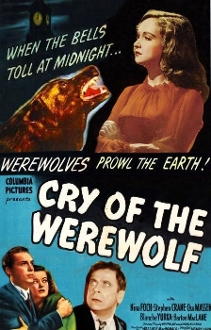
 House of Dracula
 Abbot and Costello Meet Frankenstein


