it is said that if you ask ten werewolves what a werewolf is, you will get eleven different answers
Showing posts with label wolfman. Show all posts

Thursday, 26 November 2015

The Werewolf Cinematic Timeline, Part III: 1970-1979

Hello everyone and welcome to what should probably be the analysis and review of The Wolfman, but is, instead, the third part of the Werewolf Cinematic Timeline!

Quite frankly, I have been taking much longer that I thought I would with the review, because I've been busy with many other things both in real and virtual life and so haven't had the time to enter the right mindset to sit down and continue writing. That's where the Werewolf Cinematic Timeline Part III comes in. The nature of this series of posts allowed me to keep working on the short summaries for the movies listed during short periods of time during which I was free to do something for the website. It was a pretty long process, too, because this time the number of titles increased to 28, compared with 17 titles included in Part II. It did not help that it was sometimes a little difficult to find information about the plots of some of the movies, so some extra digging was required here and there. Additionally, I was right in my assumption that I would have to cut Part III on year 1979, because there were just so many productions that came out in the 70s that the post would just be too long. Not that it's not pretty long as it is right now! So, all in all, I think sticking to the decade-by-decade division will be the best course of action.

Researching all these movies, year by year, has proven very educational for me, and a lot of fun, too. I hope that you who are reading this will also share in my experience and find something that will pique your interest. Enjoy!


1970


El Bosque del Lobo

An adaptation of a novel by Carlos Martinez-Barbeito, the movie is partially based on the life events of Manuel Blanco Romasanta, a 19th-century Spaniard who claimed that he was a werewolf after murdering many men, women, and children before he was brought to justice. The movie is said to very well portray the reality of the times, when criminal impulses were often easily misunderstood as symptoms of lycanthropy.


Los Monstruos del Terror
(The Monsters of Terror / Dracula vs. Frankenstein / Reincarnator / Assignment Terror)

The third instalment in the series of films about the werewolf Waldemar Daninsky, played by Paul Naschy. Aliens (yes, you heard it right) that run a travelling circus as a cover for their much more insidious plans decide to revive a werewolf (Count Daninsky, from whose body they extract the silver bullets he was shot with in the first movie in order to revive him), a vampire, a mummy, and Frankenstein's monster in order to use them to take over Earth. Their plan is to discover the reason why these monsters are so frightening to the inhabitants of Earth and then use them to conquer the planet. However, their plot is foiled by Daninsky, who single-handedly gets rid of the other monsters and subsequently blows up the aliens' base, after which he ends up shot with silver bullets fired by a woman that loves him enough to end his torment (AGAIN).

Nympho Werewolf 

(no poster available at the moment)

This is one of those movies that seems to have vanished from the pages of cinematic history. I remember hearing something or other about it ten years ago, back when my interest in werewolves was still new, but I have lost whatever information I might have had from that time and the only thing I could find so far is that this was a low-budget and low-quality Portuguese werewolf movie. I will post an update should I manage to find something more.

La Furia del Hombre Lobo 
(The Fury of the Wolfman / The Werewolf Never Sleeps)

The fourth movie in the series about Count Waldemar Daninsky, played by Paul Naschy. Although it was filmed in 1970, it wasn't released until 1972 because of problems its makers had to find a distributor. It is still classified as a 1970 movie, so here it will stay. Fury of the Wolfman presents a different origin story to that shown in Mark of the Wolfman of how Count Daninsky became a werewolf. Here, the Count travels to Tibet, where he is bitten by a yeti, which somehow causes him to become a werewolf. As a werewolf, Daninsky kills his wife and her lover, but then dies during his escape attempt. After that, he is revived by a mad scientist, who wants to use him in her mind control experiments. Additionally, she brings back to life Daninsky's wife, who is now a werewolf as well after her husband's fatal bite from earlier, and pits the two werewolves against each other. Daninsky kills his wife once again and is in the end shot dead by the scientist's assistant, who loves him (they could have really come up with a different end to each of these stories if they were to make sequels). 

La Noche de Walpurgis 
(The Werewolf vs. Vampire Woman / Werewolf Shadow)

The very successful fifth part in the series of movies about the werewolf Count Waldemar Daninsky, played by Paul Naschy, which picks up after the events of Fury of the Wolfman. Here, Daninsky is brought back to life after two doctors remove the silver bullets he was "killed" with in the previous movie while performing an autopsy on his (not-so-dead after all) body. As expected, the werewolf escapes from the morgue, killing the doctors on the way. He then returns home to his castle (the one from the first movie perhaps? But this is supposed to be a different continuity... I don't think there's any point in trying to make sense of all this...). This causes the townsfolk of the nearby village to start spreading rumours that a werewolf lives in the castle. While there, the count is visited by two women who are looking for the grave of a notorious murderess and, reportedly, vampire. Once they find her resting place, which happens to be in the vicinity of Daninsky's castle, they accidentally revive the vampire and become her servants. The werewolf count is then forced to battle and defeat the vampire, after which - you guessed it - he is shot dead (oh really?) by one of the mentioned women, who somewhere on the way has fallen in love with him.

Scooby Doo: Where Are You! episode 24: Who's Afraid of the Big Bad Werewolf

While Scooby Doo and the gang are out on a camping trip, they are startled by a wolf-like howl and glowing eyes watching them from inside the forest. They decide to investigate and find tracks of what they assume might be a werewolf. The tracks lead them to the empty grave of Silas Long, whose tombstone describes him as "half-man, half-wolf". The mystery deepens, as it now seems like they are facing not only a werewolf, but one that has risen from his grave.


1971


Beast of the Yellow Night

During World War II, the devil saves a man from death on condition that he become his servant and carry out his will for the next twenty-five years. As such, the man gains the ability to possess people and bring out the evil inside them. This evil, as it turns out, makes them turn into a hairy werewolf-like monster that stalks and kills other people.


Dr. Jekyll y el Hombre Lobo 
(Dr Jekyll and the Werewolf )

The sixth part of the series where Paul Naschy plays Count Waldemar Daninsky. Our protagonist (who, once again, is somehow alive after the previous film) sets out on a quest to find a cure for werewolfism. To this end, he visits the grandson of the famous Dr. Jekyll. The man gives him a serum that splits his personality similarly to Dr. Jekyll and Mr. Hyde. He hopes that this will subdue the werewolf inside the Count, but as it turns out it only leads to the creation of an even more savage monster.

O Homem Lobo
(The Werewolf)

(no poster available at the moment)

A Brazilian black-and-white film about an orphan boy who transforms into a werewolf at night during the full moon and causes panic among the inhabitants of a small country town.

Santo y el Blue Demon Contra Dracula y el Hombre Lobo
(Santo & Blue Demon vs. Dracula & the Wolfman)

Santo and Blue Demon - two of the most famous Mexican luchadores of the time - work with a couple of detectives to stop the grandson of Dr Frankenstein from performing wicked brain transplant experiments, which apparently involve turning someone into a werewolf.

Werewolves On Wheels

During a ride, a group of bikers comes across an old church, in which they decide to take shelter for the night. It soon is revealed that the church is home to a satanic cult, which drugs the bikers, making them quickly fall asleep. The same night, the cultists cast a curse on the biker leader's girlfriend, which makes her turn into a werewolf every subsequent night and one by one kill off other bikers every time they stop to rest for the night. Her curse soon spreads to her boyfriend. The two werewolves are eventually confronted by the gang in the movie's climax.


1972


Moon of the Wolf

The mauled body of a young woman is found by the police in a small Louisiana town of Marsh Island. Although she looks like she was killed by an animal, the woman's brother is convinced it was her boyfriend who murdered her. The local sheriff conducts an investigation and interviews the girl's dying father who warns him of the "loug garog" (which, later on, turns out to have been a mispronunciation of the French term "loup garou", meaning "werewolf"). Subsequently, he visits the plantation estate of a man and his sister, who are the last remaining members of their family. Asked about the night of the murder, the man answers that he suffered an episode of malaria and doesn't remember anything. After a couple more people are killed, the plantation owner's sister reveals to the sheriff that the curse of werewolfism runs in their family and that her brother has probably inherited it. In the end, she is forced to kill her brother once he turns into a werewolf during a full moon and tries to kill her.

The Rats Are Coming! The Werewolves Are Here!

This American production tells the story of a family of natural-born werewolves - the Moonies (hur, hur, hur), for that is their name - who live in rural England of the early 1900s. The father, who claims to be nearly two hundred years old, has spent many years researching possible ways to lift the family curse, but to no avail. When the youngest daughter returns home from medical school, she is hailed as the last and only hope for the family, because she is the only member of the family who does not turn into a werewolf during the full moon. However, as it turns out, she secretly has an agenda of her own and lifting the family's curse is just an excuse for pursuing her own goals.

El Retorno de Walpurgis 
(The Return of Walpurgis / Curse of the Devil / The Black Harvest of Countess Dracula)

The seventh part of the saga of Count Waldemar Daninsky, the werewolf. This time, we once again are presented with a different origin story of how the count became a werewolf. Daninsky, a wealthy man who lives in his castle, one night kills a wolf on his castle's grounds. After death, the wolf transforms into a human and it is revealed that the werewolf was a member of a band of Gypsies that were camped nearby. When the news reaches the camp, one of the Gypsy women casts a curse on Waldemar for killing one of their brethren. The woman devises a plot to punish him and sends a beautiful young Gypsy to seduce the count, which she succeeds in doing. While he is asleep, the woman gives him a bite using a wolf's skull she managed to smuggle into the castle, and the count thus becomes a werewolf. In addition to this, it is revealed that one of Daninsky's ancestors was a member of the Holy Inquisition and was cursed to become a werewolf by a woman he sentenced to burn on a stake. Said woman is then revived and the confrontation between her and the werewolf Daninsky constitutes the movie's climax.


1973


Chabelo y Pepito Contra Los Monstruos

A Mexican comedy in which two young boys decide to sneak out of their boy-scout camping trip in search of treasure and adventure. They find a cave, in which (somehow) they end up surrounded by all the classic Universal Studios monsters, including Dracula, Frankenstein's monster, the Wolf Man, and the Creature from the Black Lagoon, who they have to all outsmart in order to not get eaten.


The Boy Who Cried Werewolf

A boy named Richie is taken by his divorced father to a desolate mountain cabin for a father-and-son weekend. During a hike at night, the two are attacked by a werewolf, which the father manages to kill, but not before being bitten. Upon examining the creature's body, it appears a human once again, so the father dismisses his son's ramblings about a monster. The local police cannot identify the body, so the man is labeled as a mad drifter and the case is quickly closed. Richie, however, insists that his father killed a werewolf, which makes his mother send him to a psychiatrist. As therapy, Richie returns to his father's cabin for another few days, during which the man unknowingly transforms into a werewolf (because, of course, it's the full moon at the time) and chases after him. Richie manages to escape and finds shelter for the night at a newlywed couple's camper. He tells them he saw a werewolf in his father's cabin, but they don't believe him. The next morning, Richie's father arrives at the camper and takes his son home. That night, expecting to see the werewolf again, Richie hides inside the cabin and witnesses his father turn into the monster from the day before. When the boy tells his mother that he's afraid to be alone with his father because he's a werewolf, another visit to the psychiatrist follows. The doctor advises that the whole family spend time together in the mountains and they agree, which leads to the movie's climax where everything, and more, is revealed.

The Werewolf of Washington

An American horror comedy which is a satire on a couple individuals from the surroundings of Richard Nixon during his presidency. A reporter, who happens to have an affair with the president's daughter, is sent to Hungary. While there, he is bitten by a werewolf and contracts lycanthropy. After returning to the US, he is given the position of the president's press assistant. Having discovered that he is a werewolf, the reporter tries to tell others about it, but nobody believes him. Needless to say, soon afterwards people start getting killed off by a mysterious creature.

Blood

(no poster available at the moment)

In the 1930s London, Dr. Orlovski, who is a werewolf, keeps a garden full of man-eating plants. He teams up with Count Dracula's daughter and together they release swarms of blood-sucking bats into the city, which transform its citizens into vampire-like monsters. As is to be expected, total chaos ensues.


1974


Scream of the Wolf

An adventure writer (played by Peter Graves) is called by the police to investigate a series of murders that the authorities can't solve. The murderer leaves no clear trail and the only clues around the scenes are wolf pawprints that end abruptly and turn into human footprints. Unable to solve the mystery, the writer recruits a retired big-game hunter to track down whatever preys on the local townsfolk. Together, they begin to suspect that the killer is more than just a human.


The Beast Must Die
(Black Werewolf)

This horror is perfect for those who enjoyed playing Cluedo as kids. A millionaire invites a group of people to spend some time at his mansion in rural England. Upon their arrival, he reveals that one of them is a werewolf and must be killed before he kills the others. The people are then subjected to various tests that aim to bring out the werewolf inside - these include touching silverware, being exposed to the light of the full moon (you'd think that would work, right?) and the scent of wolfsbane. When these experiments don't bring any results and people start dying, the mansion's owner becomes increasingly desperate in his search. He makes his guests undergo a final test - to place a silver bullet in their mouths. During this test, one of the women transforms into a werewolf and jumps at the host, who kills her by shooting her with a silver bullet. However, it turns out she is not the only werewolf in the mansion and that she contracted the curse accidentally. The hunt for the original werewolf begins and once he's found, he is killed by the millionaire, but the latter gets bitten in the process. Not wanting to become a werewolf himself nor infect anyone else with lycanthropy, the man returns to his mansion and commits suicide. The movie originally included a 30-minute break where the viewers were encouraged to guess who the werewolf is, but it was later re-released under the title Black Werewolf, in which the break was skipped.


1975


La Bête
(The Beast)

A French pornographic erotic fantasy horror which (loosely) tells the story of a noble family who have financially fallen on hard times. A light of hope appears when the head of the family's best friend, a wealthy businessman, offers to marry his daughter to the noble's son. Upon arrival, Lucy (for that is her name) questions the family about some rumours she heard about ghosts and monsters appearing in the estate's vicinity, to which she is told a story of Romilda who was said to have battled a beast in the local forest two hundred years earlier. On the night of the wedding, Lucy retires to her room and dreams that she's the Romilda from the story. In the dream, she follows a lamb into the forest, only to find that it has been torn apart by a black-furred werewolf-like beast. She runs away, but the beast follows, finally catching up to her. The two then proceed to have sex. Lucy wakes up with a start and goes to the room next to hers to check if her husband-to-be hasn't visited her, but she finds him fast asleep. She then returns to bed and keeps dreaming about making love with the beast, waking up and checking on her intended two more times. Eventually, her dream ends with the beast's death (apparently from exhaustion). When she visits her future husband's room for the final time, she discovers that he is lying on the floor, dead. Having raised alarm, everyone comes to inspect the body and it is revealed that the estate owner's son is the beast from Lucy's dream.

La Maldición de la Bestia
(Curse of the Beast / Night of the Howling Beast / The Werewolf and the Yeti / Hall of the Mountain King)

The eighth part in the saga of the werewolf Count Waldemar Daninsky (Paul Naschy). Similarly to how it was done before, this movie cuts itself off from the continuity of its prequels and provides a new origin story of the main character. A yeti also appears in this one, but, unlike in the Fury of the Wolfman, is not related to Daninsky's lycanthropy. Instead, here the count becomes a werewolf after he is bitten by two female vampires (somehow, this works). Daninsky travels to Tibet in search of the yeti and is captured by two vampire women who turn him into a werewolf. In the movie's climax, he is pitted against a yeti, but fights it only briefly. This, in addition to an increased amount of nudity and gore than in the other movies in the series, disappointed the fans and Paul Naschy did not return to the silver screen as Count Daninsky for the next five long years.

Werewolf of Woodstock

A farmer who hates hippies tries to destroy some leftover equipment when Woodstock ends. As a result, he is electrocuted, which turns him into a werewolf (don't ask me how that works...). Now, every time there is a thunderstorm, the farmer transforms into a hairy beast and stalks the vicinity. Meanwhile, a band of hippies arrives in Woodstock to record their album on the famous stage so they can boast about it on the album's cover. While there, they come across the werewolf, who first attacks their dog and then abducts one of the girls and locks her up in an abandoned building. Subsequently, the farmer-werewolf also kills the local policeman and a doctor, so the authorities finally take notice. Two officers sent to investigate the scene soon figure out that the culprit is a werewolf and, in order to dispatch the beast and save the kidnapped girl, try to lure it out in the open using rock music, which it so much hates. The plan fails, however, and the werewolf escapes with the girl and heads for the nearby power station, where, after a struggle, it is put to rest with a silver bullet.

Legend of the Werewolf

Incorporating some elements of Guy Endore's novel The Werewolf of Paris, this British horror film tells the story of an orphan boy who is raised by wolves and eventually is taken in by a travelling circus and put on display as a "Wolf Boy". Once he grows up, the boy kills one of the troupe's members during a full moon and flees to Paris, where he finds a job as a zookeeper. While there, he develops a crush on one of a group of prostitutes that regularly visit the zoo. Meanwhile, he  transforms into a werewolf during the full moon and starts murdering the locals. One night, he visits the brothel where his crush works and sees her with a client, which angers him to the point that he transforms into a werewolf and kills the client and wreaks havoc at the establishment. Rejected by the prostitute, the werewolf kills even more visitors of the brothel. Soon after, a police surgeon (played by Peter Cushing) starts following the trail of murders and aims to catch what he thinks is a wolf that has escaped the local zoo.


Nazareno Cruz y el Lobo
(Nazareno Cruz and the Wolf)

The story of this movie is based on the Guarani monster of legend, the Luison, which over time, with the arrival of European settlers in America, gradually lost many of its original traits and took on the characteristics of the werewolf. The titular character is a young farmer who lives in the countryside. Just like the Luison, he was unfortunate enough to be born as the seventh son of his parents and so is widely regarded as a victim of the werewolf curse by the townsfolk. As he grows up, Nazareno falls in love with a girl named Griselda. When he turns twenty, however, the Devil appears before him and tells him that his curse is real and that he will turn into a wolf during every full moon. He gives the boy an ultimatum: if  he gives up his love for Griselda, his curse will be lifted. Nazareno refuses to do so and becomes a werewolf during the full moon and starts murdering people.


1976


La Lupa Mannara 
(Wolf Woman / The Legend of the Wolf Woman / She-Wolf / Terror of the She Wolf / Naked Werewolf Woman)

A girl who is a rape victim develops a hatred for men. As she grows up, she finds out she resembles one of her ancestors who is said to have been a werewolf. The girl then starts having dreams about being said ancestor and turning into a werewolf, so she is taken to a psychiatrist by her father. The psychiatrist concludes that Daniela may be suffering from lycanthropy (the medical condition). When Daniela's sister returns home from her studies, the woman seduces her sister's fiancee and lures him into the woods, where she kills him by ripping his throat out with her teeth. Driven insane by this, Daniela is put in an asylum, from which she escapes, however, after killing another patient. On her way, she murders another woman and then a man that tries to rape her. The authorities begin to connect the woman with the murders and set out to find her, but she is first found by a man who is so unlike the other men Daniela has met in her life that she falls in love with him. However, their happy days end when the man is killed by three burglars who break into their house and then rape Daniela. Soon after, she takes her revenge on them by ripping their throats out. Later on, she is found and captured in the forest by police officers and medical staff, and locked away in an asylum for the rest of her life.


1978


Death Moon

Due to work-related stress, a man is sent on forced vacation by his doctor. He chooses to visit Hawaii, as that's where his grandfather worked as a missionary. Once there, he finds out that his grandfather, as well as all his male descendants were once cursed by a local tribe practising Voodoo magic. The said curse makes our protagonist transform into a werewolf at night, in whose shape he begins murdering young women on the island.


1979


Wolfman

Colin Glasgow returns to his ancestral home after the death of his father. He soon learns that his family has been cursed and that his father and grandfather were werewolves and that he is next in line to become the curse's victim. He finds out that it was the local reverend, who is a member of a satanic cult, that put the curse upon his family, so he sets out on a mission to kill the reverend and free himself and his line from the fate of becoming werewolves.
O Coronel e o Lobisomem
(The Colonel and the Werewolf)

Based on the romance novel of the same title by Jose Candido de Carvalho, this Brazilian movie (which was apparently remade in 2005) tells the story of Ponciano, who inherits his father's plantation after the latter's death and is made a colonel. However, he soon feels too lonely and decides to travel to the city, where he partakes in the pleasures of life. As a result, he spends the entirety of his father's fortune, which leads him to lose his sanity. He goes back to the plantation, where, with an imaginary gun in hand, he battles many fantastic imaginary enemies, including a werewolf at the end.

* * *

And that is that for the third part of the Werewolf Cinematic Timeline! As always, if I come across something that is werewolf related that I haven't listed here, I will come back and update the post. In the meantime, I hope that it will take me less than a whole month (oh dear, has it really been that long?) to post something in the nearest future. That said, I'm not sure what the next post will be about, but if it's another part of the timeline, then I will be tackling the 80s, when werewolf movies were even more popular than in the 70s. Meanwhile, have a happy Thanksgiving and see you next time!


Friday, 16 October 2015

The Werewolf Cinematic Timeline, Part I: 1913-1949

Hello werewolf fans!

A long, long time ago (twelve years ago to be exact), there was a website about werewolves that had a huge list of werewolf movies from the very beginning to what was then the present. From what I know, the website hasn’t been around for a long time, since it disappeared from the waves of the Internet ocean still during the time when I was writing posts on my first blog as a teenager. And so, with Werewolf Theory reborn, I decided to scrape up what I had once saved from the mentioned website, revise it with my own knowledge of werewolf cinema and make a giant list of my own for all those interested to see. Because of its size, I’ve decided that it will be a good thing to split it into parts. The first part, which is this post, will cover productions from the year 1913 up to and including year 1949. The subsequent parts have their time-span yet to be determined, depending on the size of each post. The lists will mostly feature werewolf movies, but in some cases they will also list productions that are not strictly werewolf-themed, but in which werewolves have appeared for longer than just a cameo. For those I have the Werewolf Cameos series of posts. Anyway, I hope you find this list of mine informative. Enjoy!


1913 


The Werewolf

Regarded as the first ever made werewolf movie and the earliest of Universal Pictures monster movies, this silent film short tells the story of an Indian woman who becomes a witch and passes her knowledge of witchcraft to her daughter. The girl transforms into a wolf and carries out vengeance against white American settlers. The film is considered lost since it was supposedly destroyed in a fire at Universal Studios in 1942.


1923

Le Loup-Garou

A French silent film whose premise revolves around a priest who is murdered and curses his killer so that he transforms into a wolf. The werewolf begs God for forgiveness for what he has done, but instead of the curse being lifted from him, he is struck and, as a result, killed by lightning.


1925


Wolf Blood
(Wolfblood: A Tale of the Forest)

A silent film starring, and directed by, George Chasebro. It tells the story of Dick Bannister, who becomes the new field boss of the Canadian Ford Logging Company. At the time, the company is waging a private war with a rival logging company. When the conflict turns bloody, Dick is wounded and loses so much blood that he requires a transfusion. Since no human wants to volunteer, Dick is given the blood of a wolf. Medical probabilities aside, soon afterwards Dick starts having dreams of running with a pack of wolves, while the rival loggers begin dying to wolf attacks. Subsequently, his fellow lumberjacks come to the conclusion that Dick is a werewolf.


1932


Le Loup Garou 
(Werewolf)

The first sound film to feature a werewolf. Directed by Friedrich Feher and based on Alfred Machard’s novel Der Schwarze Mann, the movie has been lost to time. 


1935


Werewolf of London

The first mainstream Hollywood werewolf movie by Universal Studios. Wilfred Glendon (Henry Hull), a renowned English botanist, travels to Tibet in search of a rare mariphasa plant. While there, he is bitten by a werewolf and starts to transform himself during the next full moon. It turns out that the mariphasa plant can be made into a temporary antidote for lycanthropy, but when the flower does not bloom, Glendon goes on a killing spree through the streets of London. He tries to isolate himself from other people, but the beast within seems to always find a way to escape its confinement.


1941


The Wolf Man

The first of many movies featuring Lon Chaney, Jr. as the Wolf Man. Larry Talbot (Lon Chaney, Jr.) returns from the USA to his hometown after the unexpected death of his brother and reunites with his father. One night, as he fends off an attack by what he thinks is a wolf, he is bitten by the animal that turns out to have been a werewolf. Soon, Larry starts changing into a wolf-man and prowls the nearby woods in search of his next victim.
My analysis & review of the movie: [here]


1942


The Undying Monster 
(The Hammond Mystery)

The Hammond family has been cursed with lycanthropy since the times of the Holy Crusades, but the only thing the public knows is that its members have been dying under mysterious circumstances or committing suicide. When two people are attacked by an unknown creature, Robert Curtis (James Ellison) and his partner Christy (Heather Thatcher) are sent to investigate the crimes and find a rational explanation for what the locals believe to be a result of the Hammonds’ family curse. When the monster kidnaps a woman, the police chase it down and shoot it, revealing that the creature responsible for the attacks was a werewolf member of the Hammond family.

The Mad Monster

Dr. Lorenzo Cameron is a mad scientist seeks revenge on his peers by developing a serum made from a wolf’s blood that turns his gardener (and test subject) into a bloodthirsty wolf-man. He then uses the wolf-man to kill the fellow scientists that ridiculed his beliefs and made him lose his job at a university. A newspaper reporter begins to investigate the killings and he begins to suspect the scientist of being the culprit. In the end, the wolf-man turns on his master and kills him, while the laboratory burns down, burying all the evidence of what has really happened.


1943


Le Loup des Malveneur

A French film directed by Guillame Radot. Similarly to the family from The Undying Monster, a curse hangs upon the Malveneur family – its first-born male members are doomed to transform into wolves by night. Once a family of hunters, they are now the hunted monsters. The last member of the family, who happens to be a scientist, conducts mysterious experiments in order to find a cure and revive his ancestors. Once people start disappearing, a detective is sent to investigate. The movie incorporates themes from both Arthur Conan Doyle’s The Hound of the Baskervilles and Mary Shelley’s Frankenstein.

Frankenstein Meets the Wolf Man

The sequel to 1941’s The Wolf Man. On the night of a full moon, graverobbers break into the Talbot family crypt, where Larry Talbot was laid to rest after the events of The Wolf Man. When they remove the wolfsbane that was buried with him, the full moon’s light revives Larry, to the horror of the graverobbers. He escapes and travels to the remains of Dr. Frankenstein’s castle, where he hopes to either find a way to cure himself of lycanthropy or permanently end his life. It is there that he comes across Frankenstein’s monster.


1944


The Return of the Vampire

An unofficial continuation of Bela Lugosi’s version of Dracula from 1931, where Lugosi plays Count Dracula in all but name. Generally speaking, this is a vampire movie, so I’m not going to write a summary of it. The reason why it’s on this list is the fact that the titular vampire’s servant is a werewolf, whose lycanthropy is somehow bound to his master’s existence, for when the vampire is killed with a stake, the werewolf returns to his human form. After the vampire is revived, however, he becomes a werewolf again and once more serves his master.

The Three Stooges: Idle Roomers

A short film featuring the American slapstick comedy team, the Three Stooges. In it, the trio work as bellboys at a hotel where they are trying to win the affection of an attractive female guest. It turns out that the woman’s husband has somehow smuggled a wolf-man into the hotel. Lupe the Wolf Man, for that’s his name, goes berserk whenever he hears music, so when one of the bellboys turns on the radio while cleaning his room, all hell breaks loose.

House of Frankenstein

Another movie with Lon Chaney, Jr. in the role of the Wolf Man, this movie continues the story from 1943’s Frankenstein Meets the Wolf Man. Dr. Gustav Niemann (played by Boris Karloff) seeks revenge on Burgermeister Hussman, who once caused his imprisonment. He visits the flooded ruins of Frankenstein’s castle and finds Frankenstein’s monster and the Wolf Man frozen in the water. He thaws the two of them out and promises to help Larry Talbot find a cure for his lycanthropy. He is not one to keep his promises, however, and Larry transforms into a wolf-man and starts killing people. Eventually, Larry is shot with a silver bullet by a Gypsy girl who has fallen in love with him.

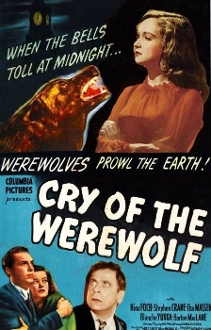
Cry of the Werewolf

Based on a story by Griffin Jay, the movie tells of a Romani princess supposedly descended from Marie La Tour, an 18th century French noblewoman. She has the ability to transform into a wolf - a trait she inherited from her mother. When she learns that the location of Marie La Tour’s tomb has been discovered, she decides to kill everyone privy to this information, because it is considered a sacred place whose whereabouts are to be known only to her family.


1945


House of Dracula

Yet another Universal Studios production that puts Dracula, Frankenstein’s monster, and the Wolf Man together on one screen. Once again, this movie continues the story of its predecessor, House of Frankenstein from a year before. Count Dracula (John Carradine) comes to the fictional town of Visaria to meet with Dr. Edelmann, saying that he is looking for a cure for vampirism. At the same time, Larry Talbot arrives at the castle (wait, didn’t he get shot in the previous film?) and wants Edelmann to develop a cure for his werewolfism. The doctor claims that Talbot’s transformations may be caused by pressure in his brain - and not by moonlight - and undertakes the task of curing him. Eventually, he succeeds in curing Larry of werewolfism by relieving the pressure in his skull (yeah right), but while trying to cure Dracula, he becomes a vampire himself.


1946


She-Wolf of London 
(Curse of the Allenbys)

Phyllis Allenby is a content noblewoman who is about to be married to an aristocratic lawyer. She lives in her family’s manor in London with her aunt, cousin, and a servant. Suddenly, people start being killed at the local park, their throats ripped by what seems to be a wild animal. Rumours about werewolf attacks spread through the city and some people claim to have seen a “she-wolf” emerge from the Allenby manor and head for the park. At the same time, Phyllis wakes up with blood on her hands, unable to remember what happened the previous night. She starts believing that she is the female werewolf responsible for the murders, affected by the legendary curse of the Allenby family.


1948


Abbot and Costello Meet Frankenstein

Abbot and Costello were the most popular American comedy duo in the 1940s and early 1950s. This movie was the first of a number of productions in which the two comedians come across classic Universal Studios monsters. Here, Abbot and Costello play two baggage clerks, Chick and Wilbur, respectively. They are contacted by Larry Talbot (Lon Chaney, Jr.) – who, for some reason, is once again a werewolf (so much for that brain pressure relieving therapy, I guess) – who tries to warn them that a shipment they’re handling is dangerous because it contains the bodies of Count Dracula (Bela Lugosi) and Frankenstein’s monster (Glenn Strange) en route to McDougal House of Horrors. As we can expect, Dracula awakes upon arrival and devises a plot to revive Frankenstein's monster and replace its brain with that of Wilbur’s. Together with Larry Talbot, the two comedians have to act to stop Dracula’s plans.

* * *

And that would be it for Part I of the Werewolf Cinematic Timeline. Phew, I have to say it took me a while to get all these short summaries together. I actually had to cut the post earlier than planned, because it was getting too long. Stay tuned for Part II, which will list productions from 1950 up to and including 1979 (at least that’s the plan), where their numbers begin to visibly increase. See you next time!

Tuesday, 25 August 2015

Cinema & TV: Wolf Children (2012)

Hello and welcome to another dose of shapeshifting extravaganza!

Recently, as I was backing up my old werewolf movie reviews, I realised I haven’t written a review for four whole years. It’s astounding how fast time flies. In response to this, I decided to write something of the mentioned sort, so this time we’ll be looking at a production a little different from the usual werewolf movies – an animated film, Hosoda Mamoru’s Wolf Children.

In order to create Wolf Children, Hosoda established Studio Chizu, which co-produced the movie with studio Madhouse (known for animating well-known titles such as: Cardcaptor Sakura, Chobits, Death Note, Marvel Anime, Hellsing Ultimate, Trigun, Vampire Hunter D: Bloodlust, and many more). The movie’s characters were designed by Sadamoto Yoshiyuki – the character designer for Neon Genesis Evangelion.

The production had its international debut in June 2012 in France, a month before it began screening in Japan, and was an immediate success, becoming the second-highest grossing film in its home country on its debut weekend of 21-22 July (the number one highest-grossing film at the time being Disney Pixar’s Brave). Following its success, Hosoda has been numerously hailed as a successor of Miyazaki Hayao and the influences of Studio Ghibli’s productions are visible throughout the movie. Wolf Children was well received by critics, scoring 93% on Rotten Tomatoes and obtaining a rating of 7.2/10 on Metacritic.
Click here to shop for
Wolf Children on Amazon!

Since I am now part of Amazon’s Affiliate program, you can directly support me by purchasing a copy of your own of Wolf Children from Amazon! Should my analysis and review spark your interest in the movie – or should you want to view it yourself before reading this article – please consider buying it through the link provided next to this message. Simply click on the cover of the Blu-Ray version of the movie on the right-hand side and you will be sent to a page listing all the offers related to Wolf Children! Unfortunately, at this moment the movie is not available on Amazon Video due to Amazon's agreement (or lack of thereof) with the Japanese distributor, so the only copies for purchase are physical Blu-Rays and DVDs.

And so, after this short introduction, it’s time that we took a closer look at the movie – not from the perspective of a general movie critic, but from the point of view of a lycanthropologist.

Summary

Wolf Children follows the life of a young woman named Hana, who falls in love with a mysterious man she meets during university lectures. When their relationship becomes serious, the man reveals to Hana that he is a werewolf, but the two remain together regardless. They live happily for a few years and have two children, but their happiness is cut short by the man’s death. As a lone mother, Hana has to face the hardships of bringing up her two half-human half-wolf children, looking on as with the passage of time they choose their own paths in life and decide whether they want to live as humans or wolves.

In-depth Analysis & Synopsis

As we learn at the beginning, the movie is narrated throughout by Yuki – Hana’s daughter, whose recount of the events of her mother’s life is the basis of the plot. We do not know if at this point in time Hana is still alive (and Yuki tells her story as an homage) or if Yuki has children of her own (and wants them to know their grandmother’s story) or if she is telling the story simply so that it’s not forgotten.

Initially, the action takes place in Tokyo, where Hana attends university. In a dream-like vision (it is never explained if these are Hana’s dreams or simply symbolic scenes added for artistic effect), as she is lying in a meadow full of flowers, Hana sees a silhouette of a wolf approaching in the distance, which  then shifts its appearance to that of a dark-haired man. In early summer, she meets the future father of her children during one of her university lectures. She lends him her textbook and learns that he’s not a student, but attends lectures whenever he can as an auditor. The two take to each other and start dating, quickly falling in love with one another.

One summer evening, the man (whose name we never learn and who is only referred to as ‘the werewolf’ in Japanese or ‘the Wolfman’ in the English version) informs Hana that there is something important that he needs to tell her, but in the end he hesitates and puts it off until the next day. Time passes and we learn that it isn’t until winter that he builds up courage to finally reveal his secret to Hana. The secret is, of course, the fact that he’s a werewolf. The two meet on a hill overlooking Tokyo and, having made sure that they are alone, the Wolfman asks Hana to close her eyes. He then transforms into his humanoid wolf form in front of her, completely taking her aback. 


One thing to note here is that for some reason, when he first transforms, his eye colour changes from his human form blue to yellow, but then after he’s done it goes back to being blue. I’m not sure whether this is intentional or just a small mistake in colouring. When I think of some later moments in the movie, there are times when the werewolves’ eyes change colour to red to signify anger, but since generally they retain their human eye colour after they transform, I would say that this exception might exist simply to emphasise the effect of the first transformation that we see on screen.

As we can see, the Wolfman retains a semblance of his old hairstyle after shapeshifting, which is a recurring theme for this movie’s werewolves. They can also speak while in wolf form, their voices virtually unchanged, except for occasional growls when angered. I know that the movie’s primary aim is to tell a story and so it does have some flaws (although as far as anatomical correctness is concerned, Wolf Children does a pretty good job at presenting its werewolves) – naturally, when undergoing a transformation, one would expect the werewolf’s vocal chords to undergo a change as well. Even if one would retain the ability to speak, it would probably not be as clear and articulate as when one is human, not to mention that canine mouths aren’t made for complex human speech. Here, however, the werewolves can easily speak with their own voices after they transform, which might actually be to emphasise the fact that they are basically perfect hybrids between human and wolf, as we learn over the course of the movie.


Right off the bat, Hosoda’s production rebuffs werewolf stereotypes by stating that its werewolves do not need a full moon to transform and they are not solely about hunting and killing people. We then learn that our Wolfman is the last (of course!) descendant of the now-extinct Japanese wolf, but it is not explained what kind of descent we are talking about here.

Let’s focus for a moment on the above mentioned animal, since its significance will be important later on (and some background information is always useful – ‘the more you know’ and that kind of thing…). So, the Japanese wolf was the smallest wolf in the world, and actually included two subspecies of the wolf: the Hokkaidō wolf (Canis lupus hattai) which went extinct in 1889, and the Honshū wolf (Canis lupus hodophilax) which went extinct in 1905. Since it is mentioned that it has been a hundred years since the extinction of the Japanese wolf whose descendant the Wolfman is (and even more so since the action takes place in Tokyo, not on Hokkaidō), we can safely assume that the wolf in question here is the Honshū wolf. Both of the aforementioned subspecies of the Canis lupus were driven to extinction due to expanding human settlements encroaching on the wolves’ habitats (which caused conflicts between the animals and ranchers), the industrialisation of the country during the Meiji restoration period, and even rabies, which decimated the wolves’ population once it was introduced to the island in the first half of the 18th century. Even when the Honshū wolf was still abundant in Japan, it was so elusive that it gained almost a mythical status, blending into traditional Japanese folklore. The wolf was therefore considered a guardian of mountains and a protector of travellers. It was even believed that abandoned infants could be picked up and raised by wolves. These beliefs are present in many modern works that take from Japanese lore, the two most obvious examples that come to my mind being Studio Ghibli’s Princess Mononoke, where there is a great white wolf-god called Moro, and Clover Studio’s video game Ōkami, where the great goddess Amaterasu takes on the form of a white wolf to fight against the evil Yamata no Orochi.

Coming back to Wolf Children, we don’t know exactly how such perfect hybrids as the Wolfman’s kin first came to be, but maybe it is better not to think about it too deeply, for we might come up with something not as pleasant as we would like to. It’s a pity that the movie didn’t care to provide a little bit more exposition about the origins of its werewolves, though. My guess is that for an ordinary viewer this information wouldn’t be at all that important, it’s only us werewolf-crazy people that always nitpick so much. Maybe it was a question too difficult to come up with an answer to for Hosoda? Or perhaps he simply wanted to add magic to the whole setting by steeping the Wolfman’s roots in mystery. Either way, the only things we know are what we learn from Yuki’s narration, which are things she heard from her mother who, in turn, learned them from the Wolfman. We learn that he was told about the nature of his existence by his parents, which suggests that at least one of them was also a werewolf (unless they took him in, but that is just speculation). They also forbade him to tell anyone about it for his own safety and soon after apparently they both died (it is not explained how), which forced him to spend his childhood in the care of relatives oblivious to his being a werewolf. After a troubled childhood, the Wolfman decided to get his driver’s licence and start working in Tokyo, where he lived hiding his true nature from everyone around until he met Hana.


The girl is at first shocked, but she decides not to break up with the Wolfman and accepts his werewolfism. The two then have sex and soon after the Wolfman moves in to live with Hana in her apartment. They enjoy a blissful life together, but soon the first troubles of being the wife of a werewolf appear when Hana learns that she is pregnant. Scared of what the doctors might find in her belly, she decides to learn about natural childbirth in order to give birth to her child at home, without any outside help. While she stays at home, the Wolfman continues working as a truck driver and sometimes in the evenings goes out to hunt, bringing wild fowl back home for some additional sustenance for his pregnant mate. The following winter, Hana gives birth to a daughter, who they call Yuki, because of snow that was falling that day. Contrary to Hana’s fears, Yuki is born looking like an ordinary human baby. A year after, during a rainy spring day, her little brother, Ame, is born. Their happiness is cut short, however, when one day the Wolfman disappears, seemingly without a trace. Having found the groceries and his wallet in front of their apartment’s door, Hana sets out to roam the city in search of her beloved. What she discovers breaks her heart and shatters her world.


Crossing a bridge, Hana notices a clean-up crew who are preparing to pull out a large canine out of the river. What to ordinary inhabitants of Tokyo seems nothing more than a large dog (since wolves have been extinct for quite a while), to Hana is none other than her werewolf husband. Because we can only know as much as Hana and Yuki, we have no idea what happened that lead to his death. We can only speculate based on what we are shown on-screen and the little that Yuki tells us, which is to say we can assume he went hunting for fowl after he had brought Hana the groceries, during which time something went horribly wrong, making him drown somewhere in the upper parts of the Sumida river, his body then carried downstream into the city, where it is found by a trash van.

What we immediately notice here is that after death his form remains that of a wolf and does not revert to that of a human, at least not soon after death. We do not know, however, how long he had been drifting before he was discovered. It would be quite a shock for the clean-up crew if the body of the canine they bagged turned out human later on, but since this is the only time we see a werewolf corpse in the entire movie, we have to assume that that’s not what happened and that, indeed, the Wolfman remained a wolf after death.

Heart-broken, Hana returns home and resolves to raise her two children on her own. This, at times, proves to be a little more than she had bargained for, but the girl doesn’t give up. In order to take care of the kids, she is forced to resign from college, as well as quit her part-time jobs, sustaining herself and her children only off of what their father had saved up. Yuki in particular is a handful for her mother – teeming with energy, impatient, and a glutton, she is a stark contrast of her younger brother, Ame. The children are shown to be unsure of what they are and what they want to be – humans or wolves – which is an overarching theme of the movie. It is hard, however, to talk about such serious life choices when talking about toddlers, so Yuki and Ame end up spending as much of their childhoods being wolves and half-wolves as being humans.


They are shown – or should I say, Yuki is shown, since she’s the livelier of the two – doing various things that human babies don’t do (in addition to the things babies do, of course), such as chewing on practically anything they can get hold of (books, wooden furniture), tearing pillows apart, and making a general mess of the apartment. This not only gives their mother a proper headache, but also forces her to learn both how to raise human children and study the habits and ways of life of wolves. Raising half-human half-wolf children proves quite a challenge for Hana, difficult decisions forced upon her at every turn. For instance, when Yuki becomes sick, Hana has no idea whether she should take her to a paediatrician or a veterinarian, so she decides to contact a doctor by phone. Due to the fact that the children don’t yet have full control over their transformations (just like little children burst into tears for any reason possible), Hana is forced to isolate them from other children and can only look on while other mothers and their children play with each other in the park.

But the problems just keep piling up as time goes by. The frail and moody Ame keeps crying at night, which brings angry neighbours to Hana’s doors, but this is just the tip of the iceberg. The children soon start to howl at night, just like wolves do. This, coupled with all the other antics they perform that ordinary children do not, causes the landlady to threaten Hana with eviction if she refuses to get rid of her ‘pets’. Although Hana assures the landlady that she does not own any animals, the woman will have none of it (despite not having seen any animals in Hana’s apartment, but that’s how people are). As if this wasn’t enough, soon after, Child Care workers knock on Hana’s door. Because neither Yuki nor Ame had ever been vaccinated or taken for medical check-ups, they became worried about their well-being. Terrified that they might see her children transform, Hana refuses to let them in. Sometime later, she takes them to a desolate field, so they can play outside as much as they want without anyone seeing them. Rhetorically, she asks them if they have decided whether they want to live their lives as wolves or humans, but the kids are still too young to understand her meaning. For them, being what they are is natural, so they don’t see any reason to choose.


Hana decides that the only way for her family to live unbothered by urban society is for them to move to the countryside. Through an estate agent, Hana and her children travel to the countryside in search of a new home. To the estate agent’s surprise, the woman decides to settle in an abandoned house near the hills (this setting gives off a serious My Neighbour Totoro vibe, by the way), where one has to travel a few kilometres to find the nearest neighbours. For our werewolf family this is the perfect place to live without any intrusions. During Hana’s dialogue with the estate agent, we come across another characteristic belief related to the figure of the wolf in Japanese culture. The estate agent informs Hana that it will probably be impossible for her to grow any produce of her own because the nearby field is often ravaged by wild animals that come down from the mountains. In Japanese folklore the wolf, as guardian spirit, would often protect farmers’ plots from animals that would otherwise ruin the crops – so we can be sure that our family will have no problems with keeping it clear. It is also mildly implied that the house Hana chooses was the home of her werewolf partner – the mountains in the area look exactly as the ones in a picture he was carrying, while inside the house there are signs that someone had been raising children in it in the past.

Finally, Yuki and Ame can do whatever they want without fear of being seen by other people. The opposing personalities of the two siblings begin to show – Yuki is a night unstoppable force of nature; she hunts, chases cats, climbs trees, while Ame prefers to either stay with Hana (observing her as she works towards renovating the house) or hide behind his sister’s back as he watches her antics. While Yuki is the strong, independent one, the frail Ame finds himself attacked and injured by wild animals.


Soon, the time comes for Hana to teach her children about who they are and how they should behave – she tells them it is their secret and that they should never transform into wolves in front of other people because they would create a panic. She also asks them not to act arrogant in front of forest animals, if they ever meet any.

But as the children grow, questions about their identity begin to appear one after another. Ame reads a fairytale about a big bad wolf being chased away by village hunters, which makes him question why wolves are so disliked by humans. While Yuki embraces her lupine side and quickly learns how to hunt small animals, Ame becomes miserable about being a wolf, arguing that humans hate wolves and that in stories wolves are always the villains who get killed in the end – because of which he refuses to be a wolf. On the other hand, having overheard Hana’s conversation with some neighbours, Yuki pesters her mother that she send them to a nursery school and wants to know why she hasn’t done so already. When Hana refuses to send Yuki to a nursery school, the girl throws a tantrum and keeps saying that she would manage to keep her secret among other children. Hana begins to realise that inevitably she will have to take the risk and let the energetic Yuki go to school.


In the meantime, however, winter arrives with all its snowy glory, bringing with it an incident that, in the long run, will have a profound effect on the family’s future. On one winter morning, when snow covers everything in sight, Hana takes her children to the forest so they can play in the snow. Yuki and Ame run as fast as they can through the snow as wolves, with Hana following them as fast as she can and picking up the clothes they leave behind when they shapeshift. Unfazed by the cold because of their wolf fur, the kids have a great time and the day seems to be just perfect… until Ame sees a belted kingfisher land on a rock in the nearby river. Suddenly, up until now dormant instincts awaken the hunter inside him and he leaps and catches the bird in his jaws. Proud of his accomplishment, Ame starts heading back onto the bank, but trips over his scarf and falls into the water. The strong current starts carrying him downstream and the little wolf can hardly keep his head out of the water. Turning back into a human, he calls for Hana’s help, but she is too far away to come to his aid quickly enough. In the chaos, the river’s current causes the boy to hit his head on a protruding rock and he begins to drown. Luckily, Yuki, who was still nearby and noticed the disappearance of her brother, comes to his rescue. Hana arrives at the scene soon after and finds an exhausted Yuki and a naked Ame lying on the river’s bank. Afraid that he’s dead, Hana starts trying to wake him up and is relieved when he starts speaking to her. The event proves to be a life-changing moment for Ame – he tells his mother how good he felt when he caught the kingfisher, saying that he felt as though he could do anything and that finally he wasn’t afraid. From that day onwards, as Yuki describes, the boy becomes a completely different person.

Winter ends and Yuki turns six. She starts doing everything in her power to persuade her mother to let her go to elementary school (instead of being home-schooled, I suppose). Seeing her determination, Hana agrees, but forbids Yuki to turn into a wolf among other children. To seal the promise, she teaches Yuki a short nursery rhyme which she tells her is a spell that will prevent her from turning into a wolf. Of course, this is all just make-believe, but it adds the little girl confidence that she will manage to keep her wolf side hidden. Yuki is beyond herself with happiness on her first day at school. Although at first she loses a bit of confidence, for the first time being surrounded by so many people, but she quickly adapts and makes friends. She doesn’t have to turn into a wolf to prove a little different from other children – she eats a lot more than others (though, she has always been a glutton, so it might not have anything to do with her being a werewolf) and can run faster and for longer periods of time than other children during P.E. lessons.

Once Yuki goes to school, Hana decides to start looking for a job. When Ame points out the picture of a wolf on a recruitment poster for the local natural park, Hana decides to take him with her to the meeting of possible candidates for park ranger assistants. She takes the job despite the low pay in order to learn more about the local wildlife, hoping that the knowledge she gains while working will help her in raising her children. 


By Hana’s request, the chief park ranger leads them to where the wolf from the poster is held. The chief explains that it is a timber wolf supposedly born in the Moscow zoo, which was then taken in by a wealthy someone who received a special permit to raise it, but when they passed away, the wolf was brought in to the park’s shelter and stayed there ever since. When the chief leaves the room for a moment, Hana tries to get the old wolf to give her advice on how to raise her son, but the animal just gives her a lonely stare. On their way back from the park, Ame comments that the old wolf seemed very lonely and asks if his father looked like him, which Hana denies. The boy wishes he could have meet his father and Hana understands his feelings.

Meanwhile at school Yuki is in for quite a shock when, in time, it turns out that her interests differ greatly from those of other girls. To say she is a tomboy would probably be an understatement. While her friends weave flower wreaths and find four-leaf clovers during an outing, Yuki presents them with a snake wrapped around her arm, which scares the living daylights out of the other girls. On another occasion, the girls bring their ‘treasure boxes’ to school to show off what they got from their parents (which usually turns out to be jewellery) – and are again scared and disgusted when Yuki’s box turns out to be filled with animal bones, skins and pines (trophies of her hunts and adventures in the woods, possibly). All this causes Yuki to become treated with an increasing distance by her classmates. Embarrassed by this, the girl makes a resolution to behave as womanly as she can so that she’s accepted by those around her. When Hana asks why she won’t just be who she is, Yuki replies angrily that she doesn’t want to be considered a weirdo. This aspect of her personality – her eagerness to fit into the human society – becomes her defining trait, as well as something that will later cause conflict between her and her brother.

A year later, Ame reluctantly enrolls at the same elementary school as his sister. It quickly becomes evident that school is something not for him. In an environment where Yuki flourishes, Ame finds himself lonely and disinterested (and later on bullied by his classmates). All in all, he lasts less than three years at school before he starts playing truant. In a symbolic scene where the boy stands at a crossroads near home (one way leading to where the school bus stops, the other way leading to the natural park), Ame shows that he is more interested in accompanying his mother to her work at the natural reserve. While she’s working, he spends time in the company of the old timber wolf, transforming into his anthropomorphic wolf form in front of him. It is visible that Ame is greatly missing a fatherly figure in his life.


In the meantime, a boy by the name of Souhei transfers to Yuki’s class. He instantly proves a nuisance to Yuki when he asks her if her family has a pet dog. When the girl asks why he thinks that, Souhei replies that she smells of dog fur. Yuki is taken aback by the boy’s remark, because no one else pointed such a thing to her before, and becomes afraid that her secret might come to light.

Now, this situation proved some food for thought for me. Why would Yuki smell of dog in her human form and why would Souhei be able to notice it? The answer to the former could be that the scent of a wolf could remain on Yuki after she transforms, especially on her hair, because unlike many werewolf incarnations she does not grow all of her hair when she turns into a wolf – as it is show numerous times throughout the movie, the hair on her head remains largely unchanged when she shapeshifts. This leads me to believe that a canine scent could remain on her hair even after she’s gone back to being a human. In this case, it would mean that either nobody else asked Yuki about it because they straight-up dismissed it as her having a pet dog, or that Souhei happens to have a very keen sense of smell (which does happen sometimes; and don’t worry, he’s just a human, as the movie eventually shows us – or, to be precise, doesn’t show us it being otherwise). Another theory I had is that Yuki retains a nearly-absent lupine scent which can only be smelled by those with very good noses… for example, dogs. This theory would explain why dogs always bark at our werewolves – they are able to notice that they smell like wolves, but look like humans. This is, of course, an idea that doesn’t take into account any pheromones produced by the werewolf’s glands even when in human form (remember all those times werewolves in human form are shown to possess a nigh irresistible sex appeal?), not to mention dismisses any supernatural reasons why a man’s best friend would see through a lycanthrope’s disguise.

Either way, Yuki decides that it will be best for her to avoid further interaction with her new classmate. But, much to her dismay, Souhei becomes persistent in trying to find out why she’s giving him the cold shoulder, in spite of being repeatedly told by her that it’s nothing he should be concerned about. Stubbornly, he follows Yuki and eventually corners her, trying to force her to tell him the truth. Although she keeps repeating the rhyme her mother taught her when she first went to school, Yuki is so scared that she loses control. Partially transformed, she punches Souhei and injures his ear.


Hana is then called to come to the school from work, where she and Yuki are confronted by Souhei’s livid mother in the principal’s office. Embarrassed, terrified, and sad about what happened, Yuki is forced to apologise (despite the fact that if Souhei hadn’t been so stubborn, the incident might’ve never happened in the first place). In the midst of Souhei’s mother’s threats of lawsuit, the boy says that he was hurt by a wolf, which horrifies Hana. When the meeting is over, Yuki tells her mother that ‘the spell’ didn’t work however many times she repeated it. She says is afraid that she will be expelled from school and that they won’t be able to live in their countryside house anymore before bursting into tears.

Souhei, however, does not give up. One afternoon, instead of going home, he takes the school bus and visits Yuki’s house just before Hana arrives back from work. Seeing the car approach, he leaves a sheet of paper on the doorstep and runs away. It turns out that it is a handout from class for the absent Yuki who is lying in bed, depressed. Unwilling to confront him, Yuki stays at home, while Souhei apparently tries to win her forgiveness and friendship by leaving her gifts, as well as bringing her handouts and homework on his way back from school. On one such occasion Hana asks him inside, because Yuki’s gone to visit her best friend. She asks him why he said that a wolf hurt him, to which he replies that he was sure he saw a wolf for a split second before he fell to the ground and that by saying it was a wolf he meant to defend Yuki, but nobody believed him. When asked if he hates wolves, Souhei disagrees. After that, although still a little reluctantly, Yuki goes back to school and becomes friends with Souhei.


At the same time, Ame informs Hana that he is going to meet ‘the Teacher’ (or ‘the Master’, depends on how you want to translate it) on the mountain. He explains that he calls him that because he teaches him a lot about the mountain forest, as well as life in general. Hana assumes he’s talking about someone living up on the mountain and praises her son for becoming friends with someone older, but when she asks Ame to bring him home sometime, the boy replies that the Teacher doesn’t want to meet humans and that he doesn’t come down from the mountain like boars and bears. At this point Hana realises that the Teacher isn’t human, but doesn’t say anything. Instead, she agrees to go meet him when Ame proposes that the Teacher may let her see him. It turns out that the Teacher is an old fox that lives in the forest near a great tree. Still astounded by this revelation, Hana thanks him for taking care of Ame and offers him food, which he accepts. Wolf-Ame is then shown run off into the forest with the Teacher. Following the old fox’s lead, Ame learns how to climb mountains, how to hunt small animals, where to find fresh water to drink, and observes the life of forest animals like only one of them could.

The Teacher sparks in Ame an awe at and a love for the wilderness surrounding his home. Ame eagerly tells Hana about what he’s learned about the forest and its inhabitants when he accompanies her to work. Seeing the grin on his face when he recounts all these things, Hana realises that this is what really makes him happy. One evening, however, this becomes the source of conflict between him and his sister. While Yuki’s doing homework, Ame tries to persuade her to let the Teacher teach her as well, telling her about the skills she would gain or improve upon if she did so. She refuses and in reply asks him why he won’t come to school. They quickly begin to argue after Ame states that he won’t go to school because he’s a wolf and all that he needs to know is on the mountain, while Yuki tells him that he is also a human and so he should go to school like she does. Yuki also reveals to him that she decided to never turn into a wolf again, because she wants to be a human. The scene is a decisive moment for the siblings, as it represents how divergent from each other their paths in life have become over the years. With neither side able to persuade the other, the argument turns into a wolf-on-wolf fight. The two wolf siblings thrash the interior of the house, with Hana powerless to talk sense into them. Eventually, Yuki forfeits the fight by escaping and locking herself in the bathroom. 


Hana admits to herself that although allowing her children freedom of choice in the matter of who they want to be was what she always wanted, she can’t help feeling worried about what the future will bring.

Two more years pass (in the plot, of course!) before we enter the final part of the movie, which will bring the awaited climax of the story. Yuki turns eleven and is in the last year of elementary school (which in Japan is 6th grade). Ame has been visiting the forest more frequently than before as he devotes himself to overseeing the well-being of the mountain and its inhabitants. It is revealed that the year has seen many severe downpours, which make Ame worried about the forest creatures, including the Teacher. During his outings, he leaves home for so long that Hana begins to worry about him. On one of the numerous rainy days Ame returns home with a sad face. He tells his mother that the Teacher has injured his leg and that he will die soon since he can’t walk anymore. He says that somebody (that is, him) has to take over the Teacher’s responsibilities as the forest’s overseer. Concerned, Hana forbids Ame to go to the mountain again, arguing that he’s only ten years old and that while a wolf at ten is already an adult, he’s still got ways to go…but stops abruptly, realising that her children aren’t ordinary children. Out of motherly concern, she begs him not to visit the mountain again, but deep down inside she knows that it’s inevitable.

Forced to stay home, Ame is like a caged bird. Finally, the decisive moment comes when one afternoon a great storm comes to the countryside. Because of it, Yuki’s afternoon classes are cancelled and Hana is called to pick her daughter up from school. Rain is already pouring down from the sky and a strong wind is blowing outside. After she puts on a raincoat, Hana notices that Ame is gone. She then sees his silhouette as he is heading for the mountain and decides to pursue him, forgetting about Yuki. And yes, this is pretty much what happens for the last twenty minutes of the movie – Hana is wading through the muddy forest searching for Ame, while Yuki and Souhei (whose mother also didn’t come to pick him up) stay together at school and talk. Of course, I’d be lying if I said that’s that, since I already said this was the movie’s climax. Two important things happen on this fateful day.

First of all, Yuki shares an intimate moment with Souhei (and it’s not the kind of ‘intimate’ you’re probably thinking about). When he tells her the truth about his mother’s attitude towards him and describes how he wants to run away from home and live all by himself, Yuki decides that it would be a good moment for her to reveal the truth about what happened when she accidentally injured his ear. She tells Souhei how she envies him that he can tell the truth about himself and still smile afterwards. She then transforms and shows herself to him, confessing that the wolf that hurt him that day was really her.


Yuki says that she’s never told anyone else about this and that the inability to tell the truth about what happened to him caused her to suffer all these years. To her surprise, Souhei doesn’t seem startled – in fact, he tells her that he knew about her being a werewolf from the day of the incident, but admits that he’s never told anyone about her secret nor will he ever do so. This show of understanding moves Yuki to tears. She is finally able to get rid of the burden of guilt she’s been carrying for such a long time and achieve redemption.

Meanwhile, while still trying to find Ame, Hana slips on the muddy terrain and tumbles down a hillside. She loses consciousness and lies on the ground at the foot of the hill until nightfall. During this time she has another dream-like vision, similar to the one from the beginning of the movie. She is calling out Ame’s name, looking for him in the same meadow of flowers as before. She thinks she sees his silhouette, but as she comes closer, she finds that it’s not her son, but her late partner (one has to admit, however, that Ame is a spitting image of his father). The Wolfman apologises to Hana for the trouble he caused her and compliments her that she has raised their children well. Hana then remembers that she has to find Ame, but the Wolfman calms her down by assuring her that the boy will be just fine because he’s an adult and has found his own world which he wants to be a part of. Thus, Hana’s mind is put to rest.

Out in the real world, Ame finds his mother and carries her, still unconscious, out of the forest. She wakes up as the dawn is breaking, just in time to see her son leave. Sobbing, she calls out to him, asking if this is goodbye and apologising to him that there are still many things she would like to do for him, but won’t be able to. This makes him hesitate for a few moments, but eventually the call of the wild prevails and the now fully-grown wolf leaps back into the bushes, leaving the crying Hana behind. As the morning sun shines through the parting clouds in a symbolic image of a new beginning, Ame lets out a long howl – hearing it, Hana realises that this is how it’s meant to be and a smile lights up her face. The mythological guardian spirit of the mountain has returned.


In the epilogue, we learn that a year after that Yuki goes to junior high school and moves out to live in the school’s dormitory. Hana is shown to still live peacefully in their house in the country. In the closing scene, she is shown sitting looking at the picture of her werewolf husband. The wind then carries the howl of a wolf down from the mountains and Hana listens to it with closed eyes and a smile on her face.

Impressions & Evaluation

Wolf Children is, for the viewer, a movie adventure steeped in Japanese wolf folklore. It is an animated drama about choices every one of us has to make in order to stay true to themselves, as well as about human strength for overcoming hurdles that life puts in our way. As a werewolf movie, it’s one of those productions that provide the viewer with a quite a bit more food for thought than the usual slashers. It explores the hurdles that a half-wolf half-human being has to face living in a human society and the decisions they have to make about their lives and who they really are. As the wolf children grow up, they have to find an answer to the question which appearance is the mask they have to wear and which is the real them. In the case of Yuki and Ame, the lines they decide to draw are thick and their choices seem to be either black or white – Yuki chooses to live as a human and never change into a wolf, while Ame chooses the life of a wolf, probably never returning back to the human world. The only character that seems to successfully blend between the two worlds – and thus make the most of who he is – is the Wolfman, who works in the city as a human, but is shown to regularly hunt as a wolf. Hosoda shows that even in a country where the wolf is a figure deeply rooted in the native folklore children still read fairy tales where the wolf is demonised and feared. He also shows the lack of understanding of the society and the fear of things it doesn’t understand, which forces our characters to live in isolation for a long time. The movie does not, however, condemn the entire society – it also shows that there are those who are tolerant and open-minded (first Hana, then Souhei).

When I first watched Wolf Children, I felt moved – which is more than can be said about many other titles that I’ve seen over the years. I kept wondering what the story would be like had the Wolfman survived and I was both happy and a little sad about what happened to his children. Happy because they each found their own calling in life and had the freedom to decide who they want to be – and sad because of the way it happened and how neither of them could strike a balance between their inherent dual nature. All in all, however, in my opinion Wolf Children is a movie worth watching for every werewolf fan. The story is interesting, hilarious at times and heart-breaking at others, the animation is fluid and pleasant to the eye (if a little wobbly every now and then), and the orchestral music by Masakatsu Takagi that accompanies  it emphasises the events on-screen and clearly resembles the animated works by Studio Ghibli. Every now and then it is very refreshing to watch a werewolf movie that provides the viewer with a different perspective from the one that has been fed to us for years upon years where werewolves are portrayed as unredeemable villains. So if you’ve got two hours on your hands (yes, that’s how long this movie is) on a weekend evening, Hosoda’s Wolf Children is definitely something to watch.

9.5/10


* * *